

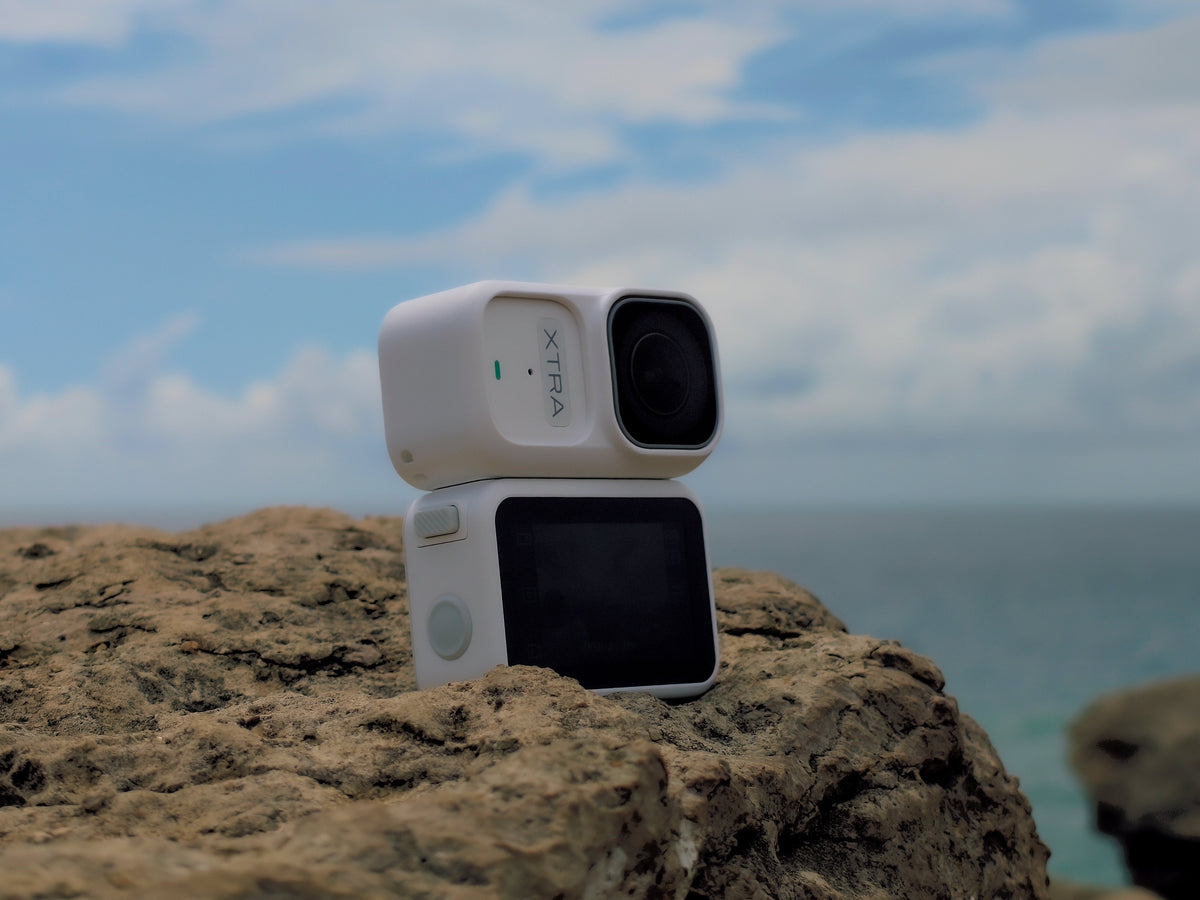
Xtra ATTO, Insta360 GO 3S, and DJI Osmo Nano are all built around a similar idea:
Make the camera small enough to wear, so you can capture the moment without constantly holding it.
But once you look beyond “small wearable 4K camera,” the three products make noticeably different design choices.
GO 3S puts a strong emphasis on minimum camera weight.
ATTO combines a larger 1/1.3-inch sensor with 4K/60fps, longer published battery figures, built-in storage, and long pre-recording.
Osmo Nano also combines a 1/1.3-inch sensor with 4K/60fps, long pre-recording, and a dock-based shooting workflow.
So which one makes more sense for travel, cycling, vlogging, long recording sessions, low light, or all-day wearable use?
This is not a hands-on test. It is a desk comparison based on official published specifications and feature design.
ATTO vs GO 3S vs Osmo Nano: Quick Specs
| Feature | Xtra ATTO | Insta360 GO 3S | DJI Osmo Nano |
| Camera weight | 54g | 39.1g | 52g |
| Sensor | 1/1.3" CMOS | 1/2.3" | 1/1.3" CMOS |
| Standard video | Up to 4K/60fps | Up to 4K/30fps | Up to 4K/60fps |
| Pre-recording | Up to 5 min | Up to 30 sec | Up to 5 min |
| Camera battery* | Up to 90 min | Approx. 38 min | Up to 90 min |
| Camera + dock/pod* | Up to 220 min | Approx. 140 min | Up to 200 min |
| Built-in storage | Approx. 107GB usable | 64GB / 128GB | 64GB / 128GB |
| Stabilization | MotionMaster + TiltGuard | FlowState + Horizon Lock | RockSteady 3.0 + HorizonBalancing |
| Standalone waterproofing | 10m | 10m | 10m |
*Xtra publishes ATTO at 54g with a 1/1.3-inch sensor, 4K/60fps, approximately 107GB of built-in storage, up to five-minute pre-recording, and up to 90/220 minutes of published battery life. Insta360 lists GO 3S at 39.1g, with a 1/2.3-inch sensor, up to 4K/30fps, 64GB or 128GB internal storage, and approximately 38/140 minutes of battery life. DJI lists Nano at 52g, with a 1/1.3-inch sensor, 4K/60fps, up to five-minute Pre-Rec, and 90/200-minute published battery figures.
*Battery numbers come from separate manufacturer laboratory tests. The test settings are not identical across all three products, so these figures should not be treated as a controlled battery test.
1. For Travel: Think About the Whole Day, Not Just Camera Size
Travel is where wearable cameras make a lot of sense.
You may want a short POV clip while walking through a market, boarding a train, hiking to a viewpoint, riding a bike, or exploring somewhere new—but you probably do not want to hold a camera for the entire day.
For this use case, three things become especially important:
weight, storage, and battery life.
If your priority is carrying the lightest possible camera, the GO 3S stands out at 39.1g.
If your priority is getting through a longer shooting day with fewer storage and battery interruptions, ATTO becomes particularly relevant. It combines approximately 107GB of usable built-in storage with published battery figures of up to 90 minutes standalone and 220 minutes with Vision Dock.
Nano sits close to ATTO in camera weight and publishes standalone runtime, while also offering 64GB and 128GB storage versions plus microSD support.
Best fit by travel style
Choose GO 3S if every gram matters.
Consider ATTO if longer-day recording, built-in storage, and fewer interruptions matter more.
Consider Nano if you want a similar 4K/60fps and larger-sensor format with a different storage workflow.
There is no single “travel winner” because a weekend city trip and an eight-hour hiking day do not place the same demands on a camera.
2. For Cycling: Frame Rate and Stabilization Both Matter
Cycling puts a wearable camera under constant motion, so stabilization is essential.
All three cameras offer dedicated stabilization and horizon-control systems: ATTO uses MotionMaster + TiltGuard, GO 3S uses FlowState + Horizon Lock, and Osmo Nano uses RockSteady 3.0 + HorizonBalancing.
Based on official specifications alone, there is no clear stabilization winner here. All three are designed to handle moving POV footage.
The more obvious difference is frame rate: ATTO and Osmo Nano support standard 4K/60fps, while GO 3S supports up to 4K/30fps.
So for cycling, ATTO and Nano may appeal more to users who prioritize 4K/60fps, while GO 3S has the advantage of lower camera-body weight. Actual stabilization performance should still be judged through matched real-world riding footage.
3. For Long Recording Days: ATTO Has the Highest Published Runtime
This is the most straightforward difference in public specifications.
Published manufacturer figures are:
Xtra ATTO: up to 90 minutes camera-only / 220 minutes with Vision Dock
DJI Osmo Nano: up to 90 minutes camera-only / 200 minutes with Vision Dock
Insta360 GO 3S: approximately 38 minutes camera-only / 140 minutes with Action Pod
Based only on those published numbers, ATTO is the strongest fit of the three for buyers prioritizing longer total recording time.
But there is an important qualification.
ATTO and Nano's published 90-minute figures are based on 1080p/24fps laboratory conditions, while GO 3S's published figure uses 1080p/30fps. Actual runtime also changes with resolution, frame rate, stabilization, screen use, Wi-Fi, temperature, and other settings.
So this table tells us about manufacturer-rated endurance.
It does not tell us how long all three cameras would last in the same 4K recording test.
If battery life is your number-one buying criterion, that matched test is the evidence worth looking for next.
4. For Low Light: Sensor Size Gives Us a Clue, Not a Winner
Low-light comparisons are where specification-based articles should be especially careful.
ATTO uses a 1/1.3-inch CMOS sensor.
Osmo Nano also uses a 1/1.3-inch CMOS sensor.
GO 3S uses a smaller 1/2.3-inch sensor.
All else being equal, more sensor area can provide more light-gathering potential.
But all else is rarely equal.
Final low-light footage also depends on the lens, exposure strategy, noise reduction, image processing, stabilization, bitrate, firmware, and how each camera balances detail against noise.
So based on public specifications, ATTO and Nano have the larger-sensor hardware advantage over GO 3S.
That is not the same as saying either one has proven better low-light video.
If low light is your number-one priority
Do not buy ATTO—or any of these three—based on sensor size alone.
Look for matched footage from the same scene, at the same resolution and frame rate, before making the decision.
That is one situation where this desktop comparison deliberately does not choose a winner.
5. For Lightweight Wearing: GO 3S Has the Clear Numerical Advantage
If your only question is:
“Which camera puts the least weight on my shirt, hat, or magnetic pendant?”
The official numbers are simple.
GO 3S: 39.1g
Osmo Nano: 52g
Xtra ATTO: 54g
GO 3S is clearly the lightest of the three.
That can matter for users who want to wear the camera for long periods on lightweight clothing or who simply prioritize minimum weight above everything else.
ATTO is therefore not the best choice for someone whose number-one requirement is the lowest possible camera-body weight.
Its design sits at a different point in the balance: 54g combined with a 1/1.3-inch sensor, 4K/60fps recording, longer published runtime, approximately 107GB of built-in storage, and five-minute pre-recording.
Nano is numerically very close to ATTO at 52g.
ATTO vs GO 3S vs Osmo Nano: The Bottom Line
These three wearable cameras do not optimize for exactly the same user.
GO 3S makes the strongest case for buyers who put minimum worn weight first.
Osmo Nano combines a 1/1.3-inch sensor, 4K/60fps, long pre-recording, and its own dock-based workflow in a 52g camera.
Xtra ATTO is particularly well balanced for users who want 4K/60fps, a 1/1.3-inch sensor, around 107GB of built-in storage, five-minute pre-recording, and longer published total runtime in one 54g wearable camera.
None of those statements proves which camera produces the best footage.
That requires a real test.
But public specifications are still useful when they are used for the right purpose:
not to declare one universal winner, but to eliminate cameras that do not fit the way you actually shoot.


Leave a comment
This site is protected by hCaptcha and the hCaptcha Privacy Policy and Terms of Service apply.