

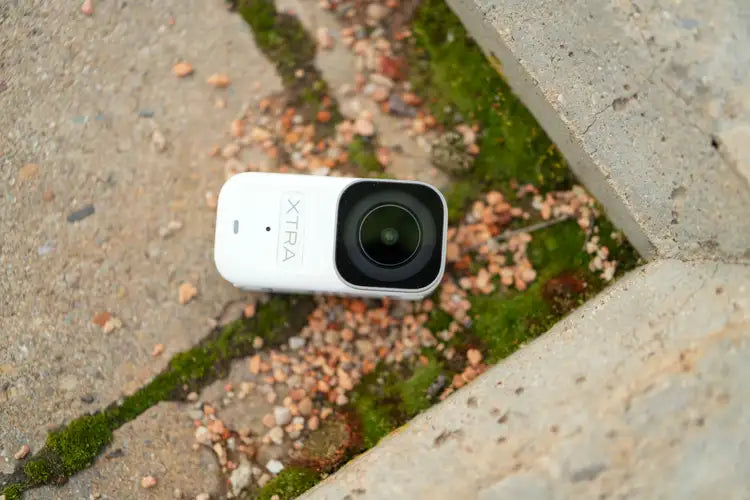
If you are comparing Xtra ATTO vs DJI Osmo Nano, the similarities are striking.
Both use a 1/1.3-inch sensor, record up to 4K/60fps, offer 4K/120fps slow motion, use a 143° field of view, include built-in storage, support up to 5 minutes of pre-recording, and are waterproof to 10 meters as standalone cameras.
So this comparison is less about basic specifications and more about price, battery life, software, audio, warranty, and ecosystem maturity.
The short answer:
Choose Xtra ATTO if you want very similar core wearable-camera hardware at a lower current price, slightly longer published total battery life, and a 2-year U.S. warranty.
Choose DJI Osmo Nano if you prioritize DJI Mimo, native DJI microphone integration, a more established accessory/support ecosystem, and a larger base of third-party validation.
Xtra ATTO vs DJI Osmo Nano: Quick Comparison
| Feature | Xtra ATTO | DJI Osmo Nano |
| Camera weight | 54g | 52g |
| Sensor | 1/1.3" CMOS | 1/1.3" CMOS |
| Max standard video | 4K/60fps | 4K/60fps |
| Slow motion | Up to 4K/120fps | Up to 4K/120fps |
| Field of view | 143° | 143° |
| Built-in storage | Approx. 107GB usable | 48GB / 107.6GB usable |
| Pre-recording | Up to 5 min | Up to 5 min |
| Camera battery | Up to 90 min* | Up to 90 min* |
| With Vision Dock | Up to 220 min* | Up to 200 min* |
| Waterproof camera | 10m | 10m |
| Stabilization | MotionMaster + TiltGuard | RockSteady 3.0 + HorizonBalancing |
| Color | 10-bit X-Log | 10-bit D-Log M |
| U.S. warranty | 2 years | 1 year standard |
| Current 128GB-class price** | $299 | $4XX |
*Battery figures are manufacturer laboratory ratings rather than one independent side-by-side test. Actual runtime varies with recording settings, temperature, Wi-Fi, screen use, and other conditions.
**Please refer to the actual price on the platform for the product's selling price.
The Core Hardware Is Closer Than You Might Expect
If you look only at the headline specifications, there is no dramatic gap.
Both cameras have:
- 1/1.3-inch sensors
- 143° ultra-wide fields of view
- 4K/60fps standard video
- 4K/120fps slow motion
- 10-bit log color options
- Dual-sided magnetic wearable designs
- Built-in storage
- Up to 5-minute pre-recording
- 10m standalone waterproofing
Even weight is effectively a tie: 52g for Nano versus 54g for ATTO.
This means buyers should be cautious about choosing either camera simply because one specification sounds more “flagship.”
The most useful question is:
What are you paying for beyond the shared hardware?
Price Is ATTO's Clearest Advantage
For the closest storage comparison, the 128GB Osmo Nano provides 107.6GB of usable space, while Xtra ATTO provides approximately 107GB usable built-in storage.
At the time of writing, Xtra ATTO is listed at $299, while Best Buy lists the DJI Osmo Nano 128GB Standard Combo at $4XX.
That is roughly a $1XX difference for two cameras with very similar core specifications.
DJI also sells a lower-capacity 64GB version, which gives buyers another price/storage option.
So ATTO's value argument is strongest when comparing it with the Nano configuration that offers a similar amount of internal storage.
Battery: Same Standalone Runtime, ATTO Goes Longer With the Dock
Both manufacturers rate their standalone cameras for up to 90 minutes under specified laboratory conditions.
The difference appears when the dock is included.
Xtra rates ATTO at up to 220 minutes total with Vision Dock.
DJI rates Osmo Nano at up to 200 minutes with its Multifunctional Vision Dock.
That gives ATTO a modest 20-minute advantage on published total-runtime figures.
Because these are manufacturer tests rather than a matched independent battery test, we would not claim that ATTO will always last exactly 20 minutes longer in real-world use.
DJI Has the Stronger Software and Audio Ecosystem
This is where DJI's longer ecosystem history matters.
Osmo Nano works with DJI Mimo, which supports device control, live preview, media management, editing, sharing, templates and other intelligent creation tools.
Nano also supports OsmoAudio direct microphone connection, including direct connection to up to two compatible DJI microphones without a separate receiver.
Xtra ATTO also has an official software path.
The Xtra App supports hardware connections, real-time preview, shooting and editing functions, while Xtra publishes firmware, manuals, tutorials and an official X-Log-to-Rec.709 LUT. Xtra also publishes a dedicated ATTO microphone compatibility chart.
The fairest conclusion is:
ATTO has an active app, firmware and creator-support ecosystem. DJI's ecosystem is currently broader and more mature, especially for integrated audio and editing workflows.
Warranty Gives ATTO a Clearer U.S. Value Advantage
DJI has a major advantage in brand recognition, retail presence, tutorials, accessories and established service infrastructure.
Its standard Osmo Nano warranty is 12 months, with optional DJI Care plans available for additional coverage.
Xtra cameras purchased through the official store include a 2-year warranty, including eligible hardware failures and battery defects. Xtra also provides U.S. customer support and local repair services.
So the distinction is not that DJI has support and Xtra does not.
It is:
DJI has the more established service ecosystem; Xtra currently provides the longer standard warranty.
What About Stabilization and Image Quality?
ATTO uses MotionMaster stabilization with TiltGuard horizon leveling.
Nano uses RockSteady 3.0 with HorizonBalancing.
Because DJI has a longer track record and a larger amount of third-party testing, we would not claim that ATTO has better extreme-action stabilization based only on specifications.
The same applies to overall image quality and low-light performance.
Both cameras use a 1/1.3-inch sensor and support 10-bit log recording, but sensor size alone does not prove which camera produces better footage.
Those questions deserve controlled side-by-side tests.
Who Should Buy Xtra ATTO?
ATTO makes more sense if you:
- Want similar core hardware at a lower current price
- Want around 107GB of built-in usable storage
- Value up to 220 minutes of published total runtime
- Want up to 5 minutes of pre-recording
- Want a 2-year U.S. warranty
- Shoot everyday POV, travel, pets, family or light outdoor content
- Do not need the deepest existing software or audio ecosystem
Who Should Buy DJI Osmo Nano?
Nano makes more sense if you:
- Already use DJI products
- Want DJI Mimo as part of your editing workflow
- Use compatible DJI wireless microphones
- Value a larger accessory and support ecosystem
- Prefer a product with more established third-party review coverage
- Prioritize DJI's longer stabilization and camera-software track record
Xtra ATTO vs DJI Osmo Nano: The Bottom Line
This is a much closer comparison than the brand names suggest.
On paper, ATTO and Nano share many of the specifications that define the actual wearable-camera experience: sensor size, 4K/60fps video, 143° FOV, slow motion, pre-recording, waterproofing and built-in storage.
DJI's advantages are primarily around ecosystem maturity, software, audio integration and market validation.
ATTO's strongest argument is value.
At the current $299 price, it offers a similar core hardware package to the 128GB Nano while adding a longer published dock-assisted runtime and a 2-year U.S. warranty.
That does not make ATTO better for every buyer.
But it does make the decision more interesting than simply choosing the better-known brand.


Leave a comment
This site is protected by hCaptcha and the hCaptcha Privacy Policy and Terms of Service apply.