

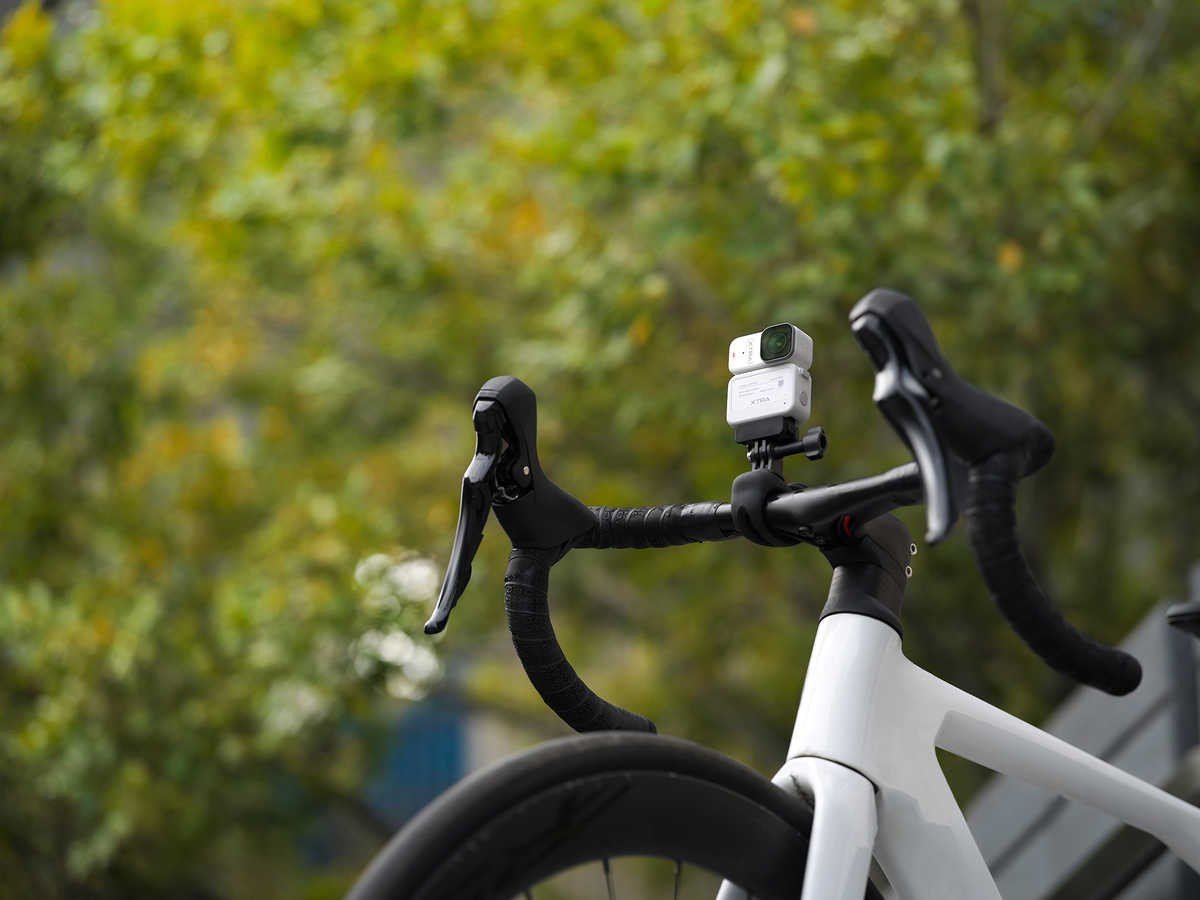
The best camera for cycling is not simply the camera with the highest resolution.
A bike camera has to deal with constant movement, changing horizons, road vibration, weather, long rides, and one obvious limitation:
your hands need to stay on the bike.
That makes cycling one of the clearest use cases for a wearable POV camera.
Instead of stopping to pull out a phone, a compact camera can stay mounted and capture the ride from inside the experience.
Xtra ATTO takes that approach with a 54g wearable body, 4K/60fps video, stabilization, magnetic mounting, built-in storage, and extended battery support.
But before choosing any action camera for cycling, here are the features that matter most.
1. Hands-Free Mounting Comes First
Cycling footage works best when the camera does not interfere with the ride.
A handheld phone is useful when you stop, but it is not the right tool for continuous first-person riding footage.
A wearable or mounted camera can capture:
- The road ahead
- Trail sections
- Commutes
- Group rides
- Stops and rest breaks
- Hands on the bars
- Changing scenery
ATTO's dual-sided magnetic design works with different mounting setups, while the included Ball-Joint Adapter helps connect the camera to compatible activity-specific mounts.
For cycling, the most important question is not how many accessories exist.
It is:
Can you position the camera securely at the angle you actually want?
2. Stabilization Matters on Every Ride
Cycling footage is still rare.
Road texture, turns, pedaling, and body movement all introduce vibration.
That makes stabilization one of the most important features in an action camera for cycling.
Xtra ATTO uses MotionMaster stabilization with TiltGuard horizon leveling, helping manage movement and keep the horizon more stable during recording.
But stabilization should not be judged by a feature name alone.
If cycling is your main use case, look for footage recorded on:
- Smooth roads
- Rough pavement
- Gravel
- Trails
- Faster descents
Real riding footage tells you more than a specification sheet.
3. 4K/60fps Is Useful for Faster Motion
Resolution matters, but frame rate matters too.
ATTO supports 4K/60fps, which can be useful for cycling because faster frame rates provide smoother motion than 30fps and give creators more flexibility when slowing clips down during editing.
This can help when recording:
- Passing scenery
- Corners
- Fast downhill sections
- Group rides
- Short action moments
That does not mean every ride needs to be recorded at 4K/60fps.
Higher settings also affect battery, storage, and heat.
The better approach is to choose your settings based on the ride rather than automatically selecting the maximum.
4. Weight Matters When the Camera Moves With You
A few extra grams may not matter much in a backpack.
They can matter more when a camera is attached to clothing, a helmet setup, or another moving mount.
ATTO's standalone camera weighs 54g.
That makes it easier to build a compact POV setup without carrying the complete Vision Dock while riding.
For cycling, think about both:
camera weight
and
the weight of the complete mounting setup.
A lightweight camera on an oversized mount can still become uncomfortable or unstable.
5. Battery Life Should Match the Length of the Ride
A one-hour commute and a full-day ride need very different battery strategies.
ATTO is rated for up to 90 minutes as a standalone camera, while total published runtime can reach up to 220 minutes with the Vision Dock under Xtra's stated laboratory conditions.
Actual runtime varies with recording settings, temperature, and usage.
For cyclists, this creates two useful workflows:
Short ride: use the standalone camera for the smallest setup.
Longer day: use the Vision Dock between clips to extend the overall shooting session.
That can be more practical than trying to record every second of a multi-hour ride.
6. Pre-Recording Helps With Unexpected Moments
Some of the most interesting cycling footage is impossible to plan.
A rider passes unexpectedly.
Wildlife appears beside the trail.
You reach a sudden viewpoint.
Something happens seconds before you press record.
ATTO supports up to five minutes of pre-recording, allowing earlier footage to be preserved when the feature is active.
For cycling, that can be more useful than simply leaving the camera recording continuously.
It gives you another way to capture unpredictable moments without creating hours of unnecessary footage.
7. Weather Resistance Is Part of the Job
Cycling happens outdoors.
Rain, puddles, road spray, and changing weather are part of the environment.
The standalone ATTO camera is waterproof to 10 meters without an additional case.
*The Vision Dock is different and should not be treated as an underwater device.
When comparing cameras for cycling, always check whether the waterproof rating applies to:
the camera itself, the dock, or the complete connected system.
That distinction matters more than the headline number.
So, What Is the Best Camera for Cycling?
There is no single answer for every rider.
A dedicated helmet camera may suit one setup.
A 360 camera may make more sense if you want to reframe your ride afterward.
A phone is still useful for stationary clips.
A wearable POV camera becomes especially relevant when you want:
- Hands-free riding footage
- A lightweight setup
- 4K/60fps video
- Stabilization
- Long rides with flexible battery management
- Quick access to recording
- First-person storytelling
That is where Xtra ATTO fits naturally.
Its 54g body, 4K/60fps capture, MotionMaster stabilization, magnetic mounting, five-minute pre-recording, built-in storage, and extended battery workflow make cycling a strong use case for the camera.
The best cycling camera is not necessarily the one with the longest spec sheet.
It is the one that lets you focus on the ride while the camera captures the perspective for you.

Leave a comment
This site is protected by hCaptcha and the hCaptcha Privacy Policy and Terms of Service apply.