

The weekend is coming. Maybe it's a road trip down the coast with no real agenda. Maybe it's a cabin in the mountains, or two nights in the desert just because the sky looks different there. Maybe it's a girls' trip that's been on the group chat for three months and is finally, actually happening.
Whatever it is, you want to remember it the way it felt. Not the way a phone camera decided it looked at 7pm with the sun at the wrong angle.
That's where XTRA MUSE fits in. It's a compact 1-inch pocket vlog camera built around the idea that the moments worth traveling for are worth filming well — without making filming feel like work.
Four travel scenarios. One camera.
The desert road trip
There's something about driving through open desert that makes you want to document every mile of it — the light on the rock formations, the nothing-for-miles stretch of highway, the gas station that shouldn't be charming but somehow is. XTRA MUSE handles desert light exceptionally well. The 1-inch sensor reads the high contrast between bright sky and dark shadow without collapsing either one. Golden hour in Joshua Tree hits different when the camera actually captures it.
The coastal weekend
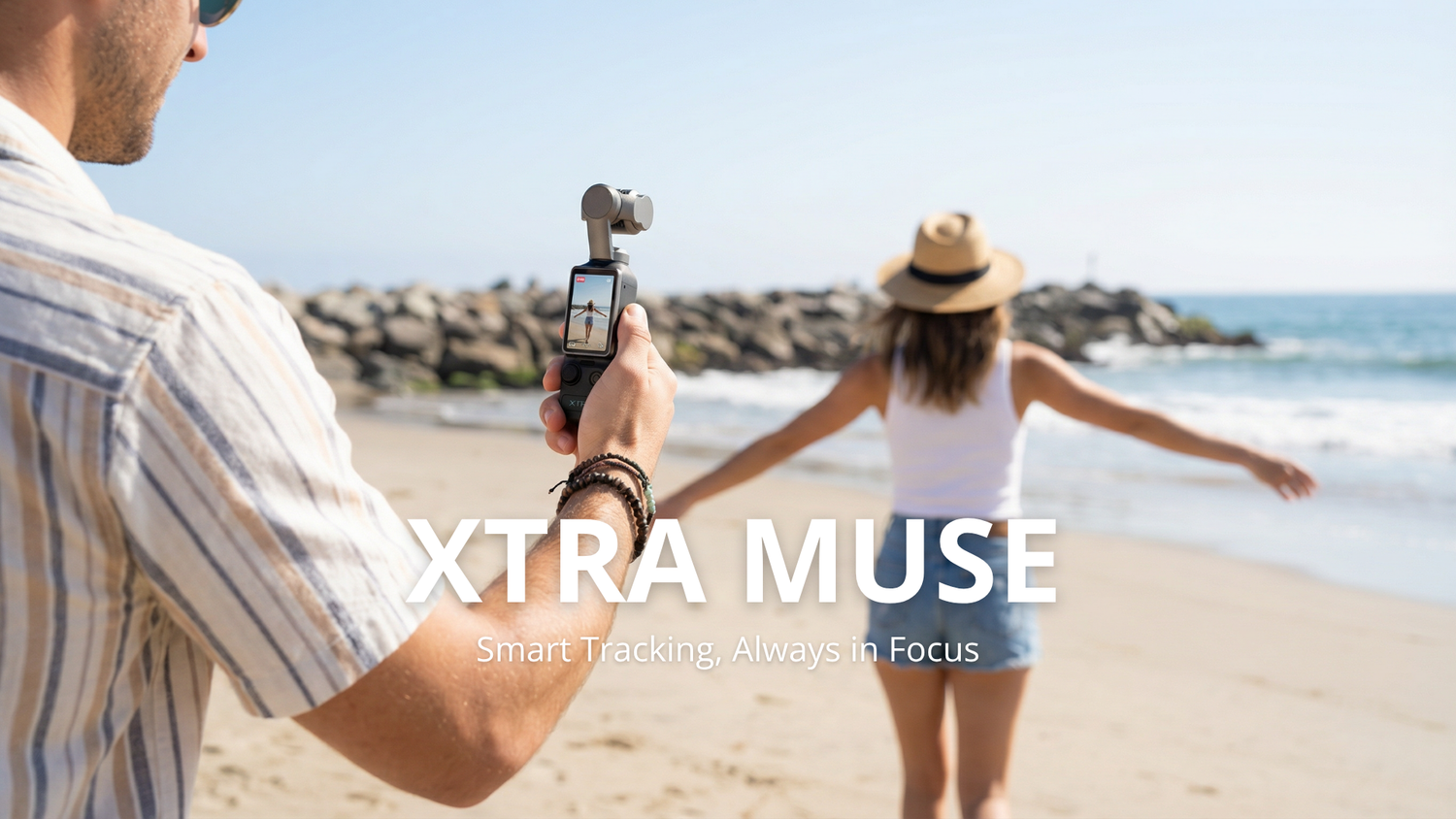
Beach footage is deceptively hard. Sand, water, harsh midday sun, fast-moving subjects — phones typically pick one thing to expose correctly and blow out everything else. XTRA MUSE's sensor latitude handles the range. And with 4K/120fps, you can slow down a wave break, a jump into the water, or the moment someone catches a frisbee, and it looks like something you'd see in an actual film. Not content. A memory that was made intentionally.
The mountain hike
The view at the top is always worth the climb. Getting there, though — the scramble, the switchbacks, the way the trees thin out and the sky opens — that's usually undocumented because nobody wants to stop moving to film it. XTRA MUSE is light enough to pull out mid-trail without breaking rhythm, and its true 3-axis gimbal stabilization means walking footage actually looks smooth. No more hiking clips that feel like a GoPro accident. Just the trail, the light, and the people you made it with.
The girls' trip that deserves a real recap
Phones are fine for the posed shots. They're not great for the in-between ones — the late-night conversation on the balcony, the moment everyone started dancing in the kitchen, the look your best friend gave you when the food arrived. XTRA MUSE's 2-inch rotatable screen means you're filming comfortably from any angle, and the fast autofocus keeps up with the energy of a room full of people who aren't waiting for you to set up a shot.
Why your phone isn't enough — and XTRA MUSE is
It's not that phone cameras are bad. It's that they're optimized for convenience, not for memory. They process aggressively, smooth out too much, and produce footage that looks clean but doesn't feel real. XTRA MUSE shoots in 10-bit X-Log, which means more color information, more latitude in editing, and footage that holds up whether you share it raw or spend an afternoon color grading it properly.
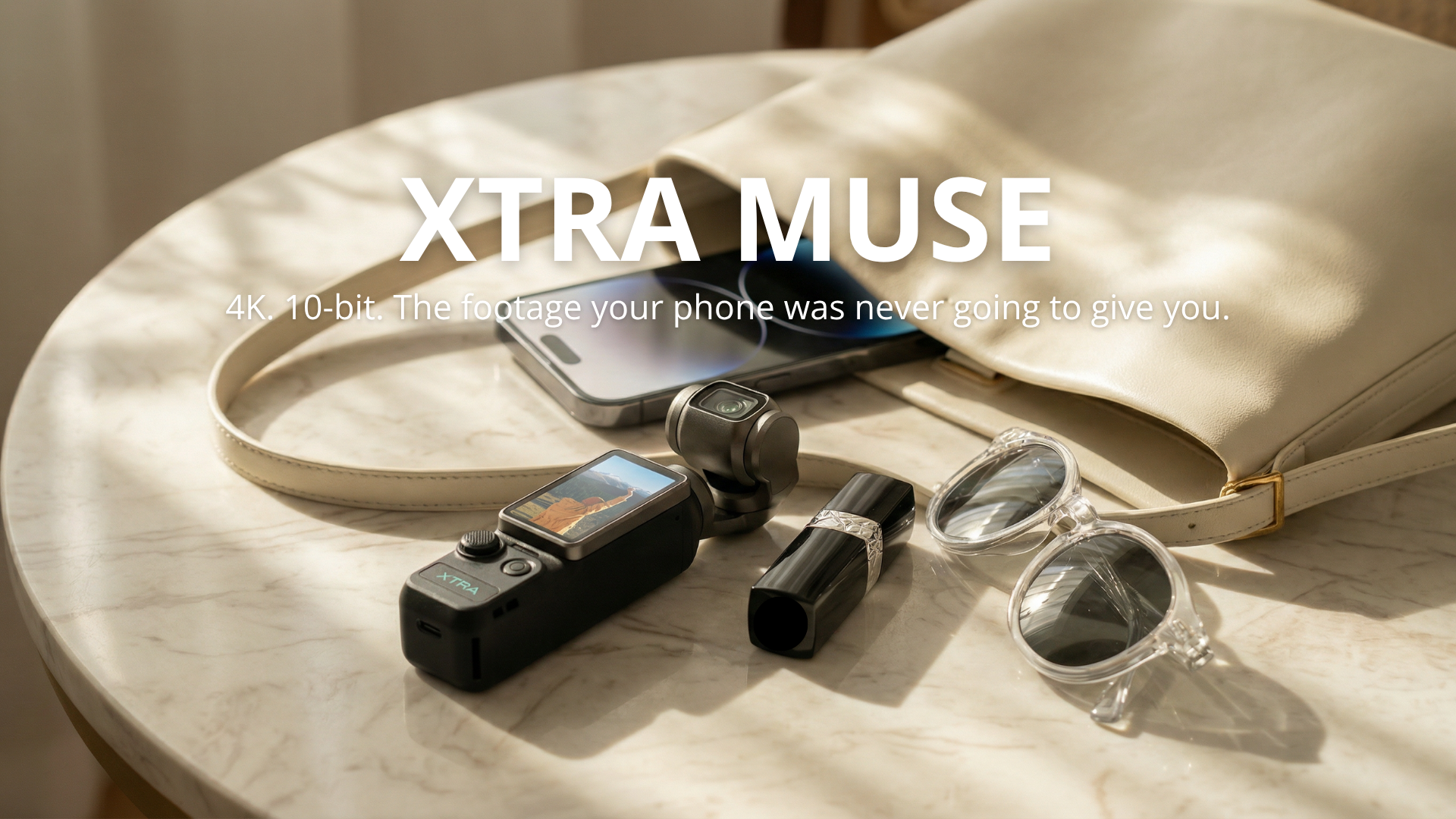
It also weighs almost nothing, fits in any bag, and starts filming the moment you twist it open. For weekend travel, that combination — small camera for travel content that actually produces cinematic-looking video — is genuinely hard to find under $400.
FAQ
Is XTRA MUSE worth bringing on a weekend trip instead of a mirrorless camera?
For most travel scenarios, yes. The 1-inch sensor delivers image quality that's genuinely competitive with entry-level mirrorless setups, and the built-in 3-axis gimbal means you skip the extra stabilizer gear entirely. It's the camera that actually makes it into your bag — which is always better than the camera you left at the hotel because it was too heavy.
Can XTRA MUSE handle outdoor and bright sunlight conditions?
Yes. The 1-inch sensor handles high-contrast outdoor environments — desert sun, beach glare, mountain light — better than phone cameras, which tend to clip highlights and lose shadow detail. The 10-bit X-Log recording gives you additional flexibility in post if you want to adjust exposure after the fact.
The Problem With Using a Phone for Travel Photography
Travel is one of the most photographed experiences in modern life, and almost everyone uses their phone to do it. The convenience is undeniable — your phone is always in your pocket. But the limitations become obvious the moment you start reviewing your footage after a trip: shaky walking shots, blown-out skies, grainy indoor scenes, and a camera roll that looks like every other tourist's camera roll.
The deeper issue is that a phone demands your attention. To get a good shot, you have to stop walking, unlock the screen, frame the scene, and tap record. By the time you have done all that, the moment has often passed. The best travel memories are spontaneous — a street performer appearing around a corner, sunlight breaking through clouds over a mountain ridge, a local market vendor handing you something unexpected. These moments do not wait for you to ready your phone.
XTRA MUSE addresses this gap. With a physical 3-axis gimbal that stabilizes your footage in real time and a Smart Tracking feature that keeps you framed even when you set the camera down, it is built for creators who want to experience their travels while simultaneously capturing them in cinema-quality video.
Tips for Getting the Best Results With XTRA MUSE
Even though XTRA MUSE is designed to be point-and-shoot simple, a few techniques can help you get dramatically better results from every session:
- Use Smart Tracking for solo shots. Set the MUSE on any flat surface — a cafe table, a windowsill, a rock — and activate Smart Tracking. The 3-axis gimbal will physically rotate to keep you in frame as you move. This is the single most powerful feature for solo creators who want cinematic footage without a camera operator.
- Shoot in 4K/120fps for social content. 120 frames per second gives you 5x slow motion when played back at 24fps. This is perfect for creating eye-catching social media clips — hair flips, dance moves, water splashes, and any fast-action moment that benefits from dramatic slowdown.
- Take advantage of the twist-to-open design. The MUSE powers on when you twist the body open and powers off when you close it. This means you can go from pocket to recording in under two seconds, which is critical for capturing spontaneous moments that disappear quickly.
- Record in vertical mode for TikTok and Reels. The MUSE's rotatable screen and gimbal allow native vertical shooting without cropping. This means full-resolution vertical content for social platforms — no black bars, no quality loss.
Technical Specifications That Matter
Understanding the technical capabilities of your camera helps you make better creative decisions. Here is what the key specifications mean in practical terms:
- 1-inch CMOS sensor: This sensor size is approximately four times larger than the sensor in a typical smartphone. More surface area means more light gathering capability, which directly results in cleaner images in low light, better color accuracy, and a more cinematic shallow depth of field that separates your subject from the background.
- 4K/120fps recording: 4K resolution provides four times the detail of 1080p. 120fps enables 5x slow motion. Together, these give you footage that holds up on large screens and social media alike, with the creative flexibility to slow down any moment for dramatic effect.
- 3-axis mechanical gimbal: Unlike digital stabilization, a physical gimbal uses motors and sensors to counteract camera shake in real time. This produces genuinely smooth footage without cropping the image or introducing compression artifacts. The difference is immediately visible, especially during walking shots, tracking movements, and any handheld recording situation.
- Smart Tracking with auto-framing: The gimbal can lock onto a subject and physically rotate the camera head to keep them centered in the frame. This is equivalent to having a dedicated camera operator, and it works reliably in most lighting conditions.
Real-World Travel Filming: What to Expect
Travel filming has specific challenges that most people do not think about until they are on the ground in a new destination. Lighting changes constantly — bright midday sun, dim cathedral interiors, golden hour that lasts 15 minutes. Audio environments shift from quiet nature trails to chaotic street markets. And the sheer volume of footage you want to capture can overwhelm a phone's battery and storage before lunch.
A dedicated travel camera solves these problems systematically. Better low-light performance means usable footage inside museums, restaurants, and evening street scenes — places where phone footage typically looks grainy and dark. Dedicated storage means you never have to choose between recording a moment and freeing up space for it. And a camera that mounts to your body or bag means you can capture authentic POV footage while keeping both hands free for luggage, railings, maps, and gelato.
The biggest advantage, though, is creative. When you use a dedicated camera while traveling, you naturally become a more intentional creator. You think about composition, about what story you are telling, about what will be worth watching when you get home. This intentionality is what separates travel footage that gets watched from travel footage that gets skipped.
Final Thoughts
The gap between phone footage and dedicated camera footage is not subtle — it is immediately visible to anyone watching your content. The XTRA MUSE brings a 1-inch sensor, mechanical gimbal stabilization, and 4K/120fps recording into a pocket-sized package that costs significantly less than cameras with comparable specifications.
Whether you are a seasoned content creator or someone who simply wants their memories to look better than what a phone can produce, XTRA MUSE is designed to meet you where you are and grow with you as your skills develop.
XTRA MUSE is available now at the XTRA Official Store with free shipping on orders over $99 and a 2-year warranty included.
Related Articles:

Leave a comment
This site is protected by hCaptcha and the hCaptcha Privacy Policy and Terms of Service apply.