

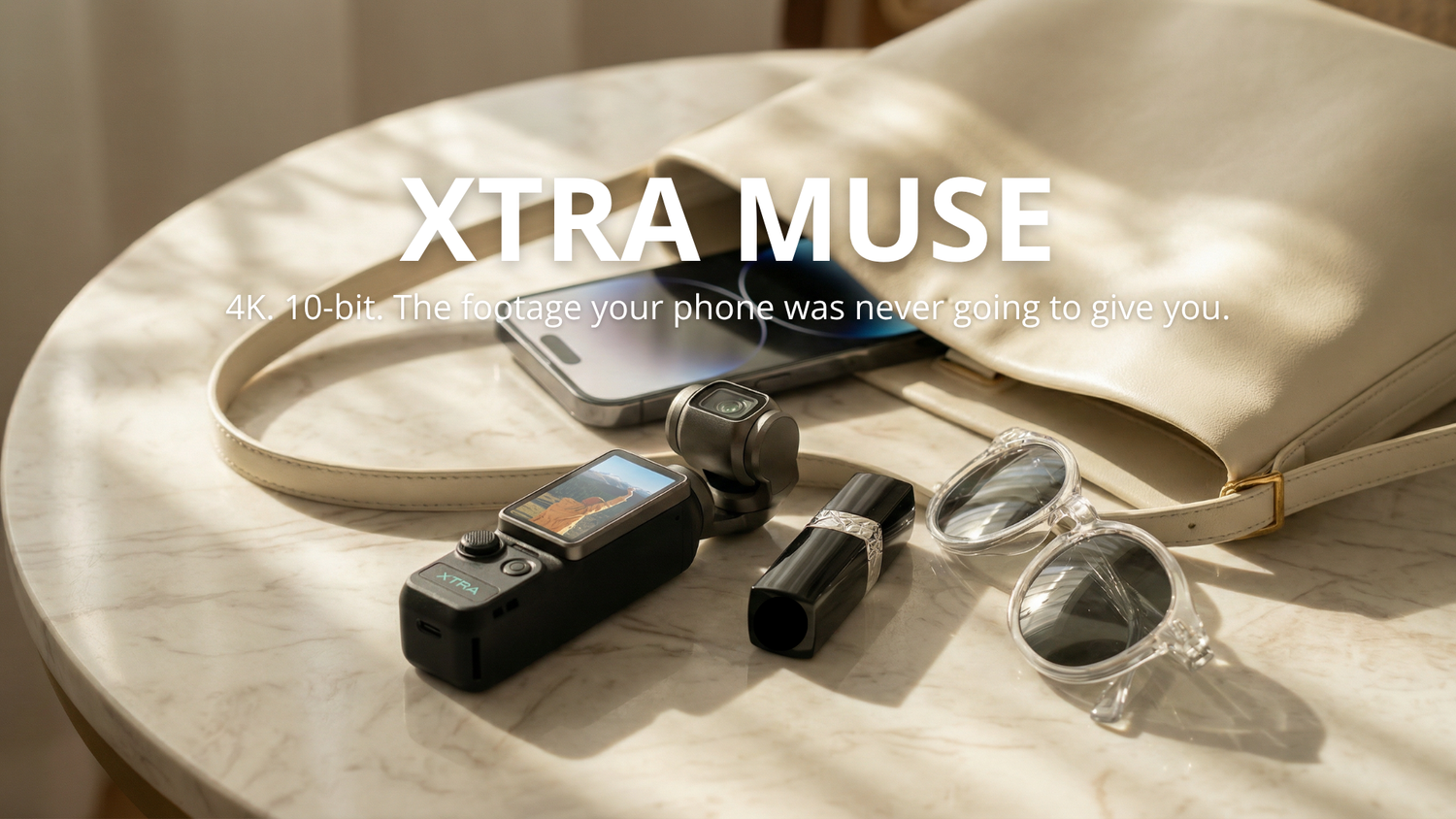
You've been there. You come back from a weekend trip, a festival, a girls' dinner that went three hours longer than planned — and you scroll through the footage on your phone and feel that slight deflation. It looks fine. It doesn't look like how it felt.
That's not a problem for you. That's a phone-camera problem. And it's the exact gap that XTRA MUSE was built to close.
This isn't about telling you your phone is bad. It isn't. It's about understanding what actually changes when you add a dedicated camera to how you document your life — and whether that change is worth it to you.
The honest side-by-side

What this actually looks like in real life
At a festival or after-dark event
Phone cameras in mixed neon and dark conditions tend to either blow out the lights or underexpose the faces. XTRA MUSE's 1-inch sensor handles that contrast range in a single exposure — which is why the footage from Neon Carnival actually looked like Neon Carnival, not a smeared approximation of it. The colors stayed vivid. The faces stayed readable. The energy translated.
On a road trip or walking through a new city
Phone stabilization is a myth the moment you're actually in motion. Walking down a cobblestone street, panning across a canyon, navigating a crowd — digital stabilization crops the frame and smooths what it can, but the result still bounces. XTRA MUSE's physical 3-axis gimbal means the footage moves with you rather than against you. It's the difference between a clip that feels like cinema and one that feels like evidence.
Filming the people you're with
The rotatable screen changes how natural filming feels in social settings. Instead of holding your phone up like a barrier between you and the moment, you can hold XTRA MUSE low, angled up, with the screen facing you — and everyone around you barely notices you're filming. That shift in camera behavior changes what people do in front of it. You get real expressions instead of posed ones.
When you sit down to edit
This is where the 10-bit X-Log format earns its place. Phone footage is already processed when it reaches you — the highlights are compressed, the shadows are lifted, the colors are decided. There's limited room to move. X-Log footage is the raw material: more information, more flexibility, more ways to make it look the way you remember it feeling. For anyone who spends time editing their travel content, this is the spec that changes the workflow.
So — is XTRA MUSE worth it over just using your phone?
If you've never felt the gap, probably not. But if you've watched footage back from a trip or a festival or a dinner that mattered, and felt that quiet disappointment — the footage is fine, but it's not right — then you already know the answer.
XTRA MUSE is a cinematic vlog camera under $400 with a 1-inch sensor, a real gimbal, and a form factor small enough to actually live in your bag. It's not asking you to become a filmmaker. It's asking you to stop settling for footage that doesn't match the memory.
👉 Discover XTRA MUSE for a pocket-sized camera that tells life-sized stories — shop now at the Official Store: https://store.xtra-us.com/pages/where-to-buy
How to Evaluate a Compact Camera: What Actually Matters
Comparing compact cameras requires looking past the marketing numbers and focusing on the factors that genuinely affect your daily shooting experience. Sensor size, stabilization type, weight, battery life, and mounting options are the five pillars that determine whether a camera will become part of your daily routine or gather dust in a drawer.
Sensor size is the single most important specification for image quality. A larger sensor captures more light, which directly translates to better low-light performance, wider dynamic range, and more cinematic depth of field. Most phone cameras use sensors in the 1/2.5-inch to 1/1.3-inch range. XTRA MUSE uses a 1-inch sensor, which is the same size found in cameras costing twice as much.
Stabilization type is equally important. Digital stabilization crops the image and applies software smoothing, which reduces resolution and can create unnatural wobble artifacts. Mechanical gimbal stabilization physically moves the lens or camera body to counteract shake without any image degradation. The difference is visible immediately, especially when walking, running, or shooting from a moving vehicle.
Tips for Getting the Best Results With XTRA MUSE
Even though XTRA MUSE is designed to be point-and-shoot simple, a few techniques can help you get dramatically better results from every session:
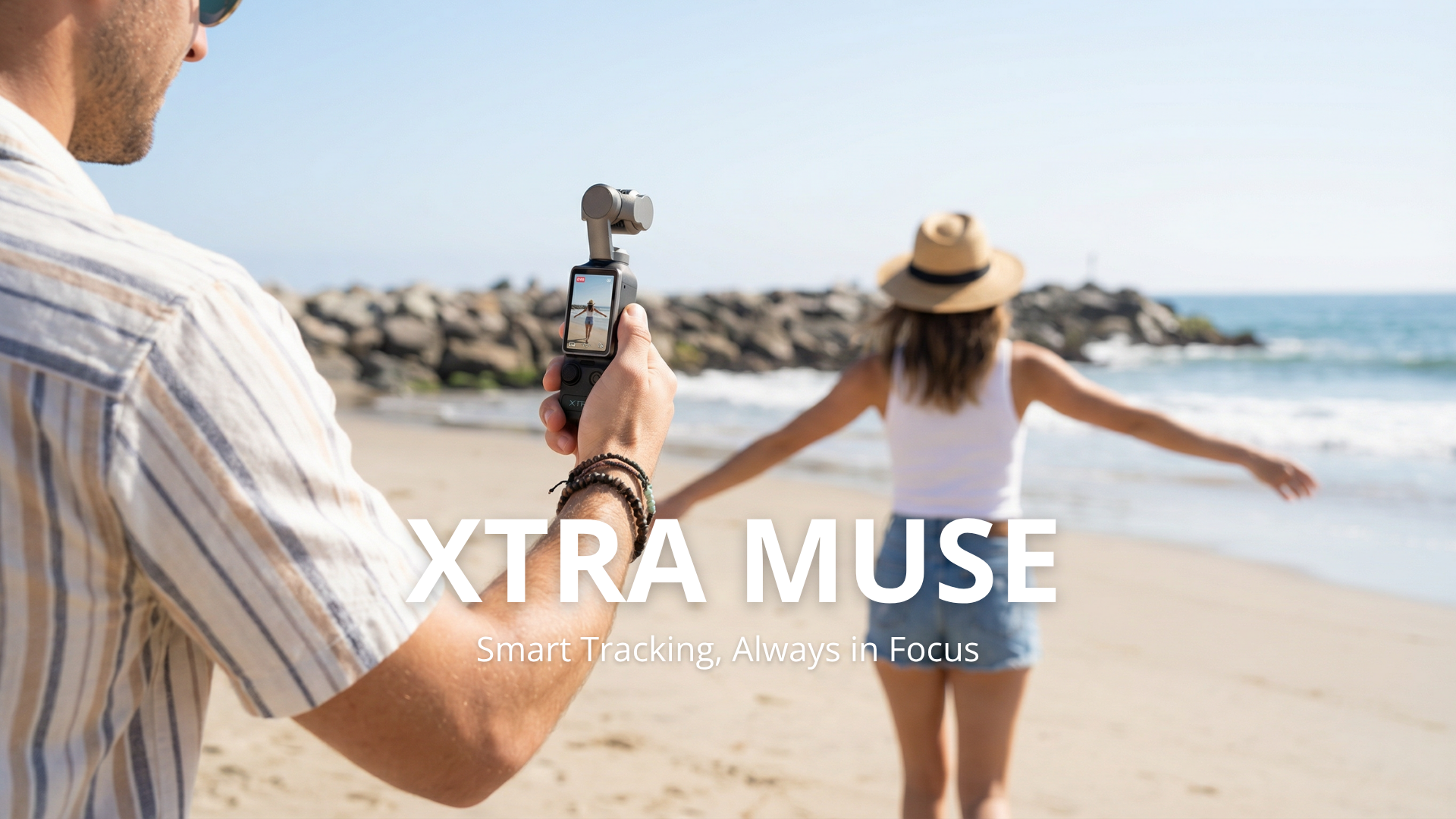
- Use Smart Tracking for solo shots. Set the MUSE on any flat surface — a cafe table, a windowsill, a rock — and activate Smart Tracking. The 3-axis gimbal will physically rotate to keep you in frame as you move. This is the single most powerful feature for solo creators who want cinematic footage without a camera operator.
- Shoot in 4K/120fps for social content. 120 frames per second gives you 5x slow motion when played back at 24fps. This is perfect for creating eye-catching social media clips — hair flips, dance moves, water splashes, and any fast-action moment that benefits from dramatic slowdown.
- Take advantage of the twist-to-open design. The MUSE powers on when you twist the body open and powers off when you close it. This means you can go from pocket to recording in under two seconds, which is critical for capturing spontaneous moments that disappear quickly.
- Record in vertical mode for TikTok and Reels. The MUSE's rotatable screen and gimbal allow native vertical shooting without cropping. This means full-resolution vertical content for social platforms — no black bars, no quality loss.
Technical Specifications That Matter
Understanding the technical capabilities of your camera helps you make better creative decisions. Here is what the key specifications mean in practical terms:
- 1-inch CMOS sensor: This sensor size is approximately four times larger than the sensor in a typical smartphone. More surface area means more light gathering capability, which directly results in cleaner images in low light, better color accuracy, and a more cinematic shallow depth of field that separates your subject from the background.
- 4K/120fps recording: 4K resolution provides four times the detail of 1080p. 120fps enables 5x slow motion. Together, these give you footage that holds up on large screens and social media alike, with the creative flexibility to slow down any moment for dramatic effect.
- 3-axis mechanical gimbal: Unlike digital stabilization, a physical gimbal uses motors and sensors to counteract camera shake in real time. This produces genuinely smooth footage without cropping the image or introducing compression artifacts. The difference is immediately visible, especially during walking shots, tracking movements, and any handheld recording situation.
- Smart Tracking with auto-framing: The gimbal can lock onto a subject and physically rotate the camera head to keep them centered in the frame. This is equivalent to having a dedicated camera operator, and it works reliably in most lighting conditions.
Real-World Performance: Beyond the Spec Sheet
Specifications tell part of the story, but real-world performance is what matters when you are actually out shooting. Here is how these cameras perform in the scenarios that matter most to everyday creators:
- Walking and moving shots: Mechanical gimbal stabilization makes the difference between usable footage and something that makes viewers dizzy. If you shoot while walking, running, or moving through crowds, gimbal stabilization is not optional — it is essential.
- Low-light and indoor scenes: Sensor size is the primary factor here. A 1-inch sensor captures roughly four times more light than a typical phone sensor, which means cleaner images, less noise, and more detail in dim environments like restaurants, evening events, and indoor venues.
- Extended recording sessions: Phones overheat, run out of storage, or get interrupted by notifications. A dedicated camera with its own battery and storage card can record continuously for hours without interruption.
- Audio quality: Wind noise is the enemy of outdoor footage. Dedicated cameras often include wind noise reduction that dramatically improves audio quality in outdoor and high-movement scenarios.
Final Thoughts
The gap between phone footage and dedicated camera footage is not subtle — it is immediately visible to anyone watching your content. The XTRA MUSE brings a 1-inch sensor, mechanical gimbal stabilization, and 4K/120fps recording into a pocket-sized package that costs significantly less than cameras with comparable specifications.
Whether you are a seasoned content creator or someone who simply wants their memories to look better than what a phone can produce, XTRA MUSE is designed to meet you where you are and grow with you as your skills develop.
XTRA MUSE is available now at the XTRA Official Store with free shipping on orders over $99 and a 2-year warranty included.
How to Choose Between Compact Cameras: A Decision Framework
If you are comparing compact cameras and feeling overwhelmed by specifications, here is a practical framework that simplifies the decision:
- Step 1: Decide your primary use case. Are you mainly shooting festivals? Travel? Sports? Everyday vlogs? Pet content? Your primary use case determines which specifications matter most. Low-light performance (sensor size) matters most for festivals and indoor use. Weight and mounting matter most for sports and active use. Battery life matters most for all-day travel and events.
- Step 2: Determine your form factor preference. Do you want a camera you hold like a traditional camcorder, or one you wear hands-free? If you want gimbal stabilization and a screen for framing, a handheld form factor like XTRA MUSE is the right choice. If you want zero-hands capture and first-person POV, a wearable form factor like XTRA ATTO is better.
- Step 3: Consider your editing workflow. Higher resolution and frame rate footage requires more storage and processing power. 4K/120fps produces stunning results but generates large files. If you edit on a phone or tablet, 4K/60fps may be more practical. If you edit on a desktop with plenty of storage, go for the highest quality your camera supports.
- Step 4: Evaluate the ecosystem. Accessories, mounts, and software integration affect your daily experience more than most people realize. A camera with a strong accessory ecosystem — magnetic mounts, charging docks, protective cases — adapts to more shooting scenarios without requiring third-party workarounds.
This framework prioritizes real-world usage over specification sheets. The best camera is not the one with the highest numbers — it is the one that fits seamlessly into your life and makes you want to pick it up every day.
What Sets XTRA MUSE Apart From Other Pocket Cameras
The pocket camera category has become crowded with options, but XTRA MUSE differentiates itself in several meaningful ways that matter to everyday creators:
- Integrated gimbal, not a separate accessory. Most pocket cameras require you to buy a separate gimbal for stabilized footage — an additional cost of $100-300 and an extra piece of equipment to carry. XTRA MUSE builds the gimbal directly into the camera body, which means stabilization is always available without any setup or additional cost.
- 1-inch sensor at this price point. The 1-inch CMOS sensor is the same sensor size used in premium compact cameras from Sony, Canon, and DJI that cost $700-1200. Having this sensor quality in a device under $400 represents exceptional value for creators who want professional image quality without professional pricing.
- Smart Tracking as a standard feature. AI-powered subject tracking is typically reserved for high-end cameras or requires a companion app. XTRA MUSE includes on-device Smart Tracking that works immediately, without any configuration, and tracks reliably in most real-world conditions.
- Vertical shooting without cropping. Most cameras shoot horizontally and require you to crop the footage for vertical social platforms, losing resolution in the process. XTRA MUSE shoots natively in both orientations, preserving full resolution for every platform.
These features combine to create a camera that genuinely replaces a phone for video content creation — not through marketing claims, but through practical capabilities that produce visibly better results from the very first recording.
Related Articles:

Leave a comment
This site is protected by hCaptcha and the hCaptcha Privacy Policy and Terms of Service apply.