

Fishing is one of those activities where the best moment usually happens when both hands are already busy.
You may be casting, adjusting gear, reeling in a fish, handling the line, or trying to land the catch.
That is exactly when reaching for a phone becomes difficult.
A fishing POV camera solves a different problem from a traditional handheld camera: it can stay with you and keep recording while your attention stays on fishing.
For creators who want first-person footage without turning every catch into a filming setup, hands-free POV can make the story feel much more natural.
Why Fishing Works So Well With POV
Fishing videos are not only about the final catch.
The experience includes:
- Preparing gear
- Casting
- Waiting
- Reeling
- Handling the rod
- Landing the fish
- Natural reactions
- The environment around you
A chest-mounted camera can capture all of those moments from the angler's perspective.
Instead of seeing someone fishing from across the bank or boat, viewers see:
the rod, the hands, the water, and the action together.
That is what makes a POV camera for fishing different from simply pointing a phone at the scene.
1. Chest POV Keeps Both Hands in the Action
For fishing, chest POV is one of the most practical camera positions.
Your hands remain visible in the lower part of the frame while the water and surrounding environment stay ahead of you.
This can work well for:
- Casting
- Changing lures
- Preparing bait
- Reeling
- Netting a fish
- Handling tackle
- Releasing the catch
The biggest benefit is simple:
the filming does not take one hand away from the activity.
A wearable camera lets the interaction itself stay at the center of the footage.
2. The Bite Rarely Waits for You to Press Record
Fishing is unpredictable.
You can wait for a long time and then suddenly have only a few seconds to react.
That creates a common filming problem:
By the time you press record, the most exciting part may have already started.
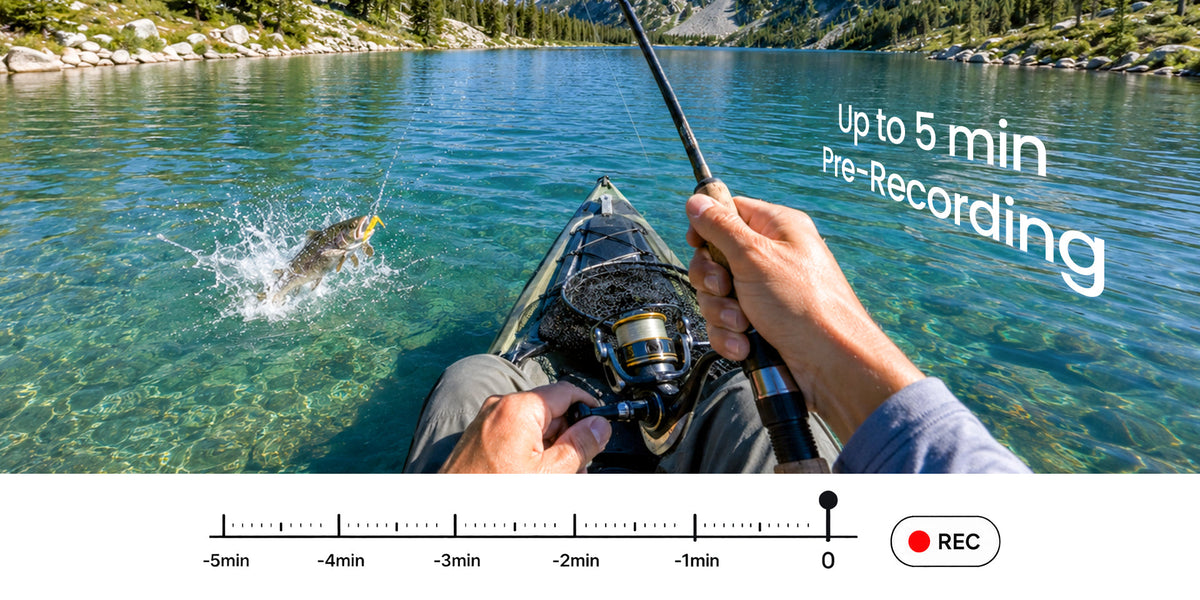
This is where pre-recording becomes particularly useful.
Xtra ATTO supports up to five minutes of pre-recording, allowing footage from before the record command to be preserved when the feature is active.
For fishing, that can help capture:
the moment before the bite → the reaction → the fight → the catch
without needing to record continuously for the entire session.
3. Stabilization Matters on the Water
Fishing footage is not always stationary.
You may be:
- Walking along a river
- Moving around a dock
- Standing on uneven ground
- Fishing from a boat
- Turning quickly when something happens
All of that introduces movement.
A practical fishing camera should be able to handle normal body motion without requiring you to manually stabilize every shot.
Xtra ATTO uses MotionMaster stabilization and TiltGuard horizon leveling, helping support wearable first-person footage while moving.
For more demanding motion—especially on boats or rough terrain—real footage is still the best way to judge how stabilization behaves in your specific environment.
4. Waterproofing Matters More Around Fishing
Water is part of the environment.
Even if the camera never goes underwater, it may still be exposed to:
- Rain
- Splashes
- Wet hands
- Boat spray
- Water near the shoreline
The standalone Xtra ATTO camera is waterproof to 10 meters without an additional case.
That can make it useful around normal fishing environments where water exposure is possible.
There is one important distinction:
The Vision Dock is not waterproof.
When using ATTO around water, the standalone camera and Dock should not be treated as having the same water protection.
5. Long Sessions Need a Practical Battery Workflow
Fishing sessions can last much longer than a typical short video.
That does not necessarily mean you need to record continuously for hours.
A better workflow is often:
record the moments that matter → stop between action → recharge or manage the camera during quieter periods.
ATTO's standalone camera is rated for up to 90 minutes, while total published runtime can reach up to 220 minutes with the Vision Dock.
Actual runtime varies with recording settings, temperature, and usage.
For a longer fishing day, the Dock can support the broader shooting workflow while the smaller camera stays wearable during active moments.
6. Built-In Storage Helps When You Shoot Lots of Short Clips
Fishing content often consists of many small pieces:
- Setup
- Cast
- POV
- Catch
- Reaction
- Detail shot
- Release
Those clips can add up quickly.
Xtra ATTO includes approximately 107GB of usable built-in storage, so you can start recording without inserting a memory card.
Footage records the camera's internal storage and can later be exported through the Vision Dock to a microSD card when more space is needed.
That makes the workflow useful for longer outdoor days where constantly managing files would interrupt the activity.
A Simple Fishing POV Shot List
You do not need hours of footage to tell the story.
Try capturing:
1. Setup
A short chest POV while preparing your rod or tackle.
2. Cast
Let viewers see your hands and the water ahead.
3. Environment
Use a short hat or fixed POV to establish where you are fishing.
4. The Bite
Use pre-recording when appropriate to help preserve the moment before you react.
5. The Fight
Keep both hands focused on the rod while the wearable camera records.
6. Catch and Release
Capture the natural reaction, then switch to a phone or another camera if you want a carefully framed photo.
That combination keeps the fishing first and the filming second.
What Should You Look for in a Fishing POV Camera?
A useful fishing camera should balance:
- Hands-free mounting
- Low camera weight
- Stabilization
- Water resistance
- Battery life
- Storage
- Pre-recording
- Fast access to recording
Xtra ATTO combines those features in a 54g wearable body with 4K/60fps recording, magnetic mounting, stabilization, five-minute pre-recording, built-in storage, and standalone waterproofing.
The most important part is not the spec sheet by itself.
It is whether the camera lets you keep fishing while still bringing the moment home.
Fishing First. Camera Second.
The strongest fishing POV footage usually does not feel like someone stopped fishing to make a video.
It feels like the viewer was there when the moment happened.
That is why hands-free filming fits fishing so naturally.
Both hands stay on the gear.
Your attention stays on the water.
And the camera captures the perspective without becoming the center of the activity.
Sometimes the best fishing POV camera is simply the one that lets you forget about filming until the moment is already worth remembering.



Leave a comment
This site is protected by hCaptcha and the hCaptcha Privacy Policy and Terms of Service apply.