

A budget action camera should leave enough money for the kit that makes it useful. We suggest $150-250 as a practical camera-shopping range, not a guarantee of specific features. Start with the recording task, then reserve money for compatible storage and a secure mount before adding optional accessories.
If you already own a working camera and have less than $100 to spend, fixing a storage, mounting or power problem may be more useful than replacing it. This guide explains how to allocate your money, rather than declaring one model best for everyone. The right budget action camera is the one that covers your actual conditions without turning a low headline price into an expensive incomplete setup.
What "budget" actually means in an action camera
Buying a budget action camera means choosing which compromises you can live with. A camera used for occasional sunny walks has different requirements from one mounted to a bicycle or taken snorkeling. An affordable action camera is not automatically good value if the necessary housing, mount or power solution pushes the complete purchase beyond your limit.
First, pay attention to the imaging system. Sensor size is a useful comparison point, but it is not a picture-quality score. Lens design, exposure, processing and the available light also matter. Do not assume a larger sensor will solve motion blur at night, or that a higher photo megapixel count means cleaner moving video.
Second, understand stabilization. Electronic stabilization adjusts and crops the recorded image; a mechanical gimbal physically moves the camera. They are different approaches, not interchangeable specification labels. Check which recording modes support stabilization and how much framing is lost. A budget action camera should be evaluated in the mode you intend to use, not just its highest advertised resolution.
Third, check water protection. A splash-resistant body and a camera rated for underwater use are different purchases. Housing requirements affect price, bulk, access to controls and audio. Follow the manufacturer's depth limits, seal checks and restrictions even when no housing is required.
| Priority | Look for | Do not assume |
|---|---|---|
| Daylight video | A useful resolution and frame rate | Low-light quality matches a flagship |
| Movement | Stabilization in your preferred mode | Every mode includes horizon correction |
| Water | A documented body or housing rating | A water-resistant label covers diving |
| Running costs | Compatible storage, mount and power | Every useful accessory is included |
Use those priorities to define an affordable action camera for your situation. A lower price with the right essentials can be more useful than a larger feature list you rarely touch.
What a $150-250 action camera can realistically do
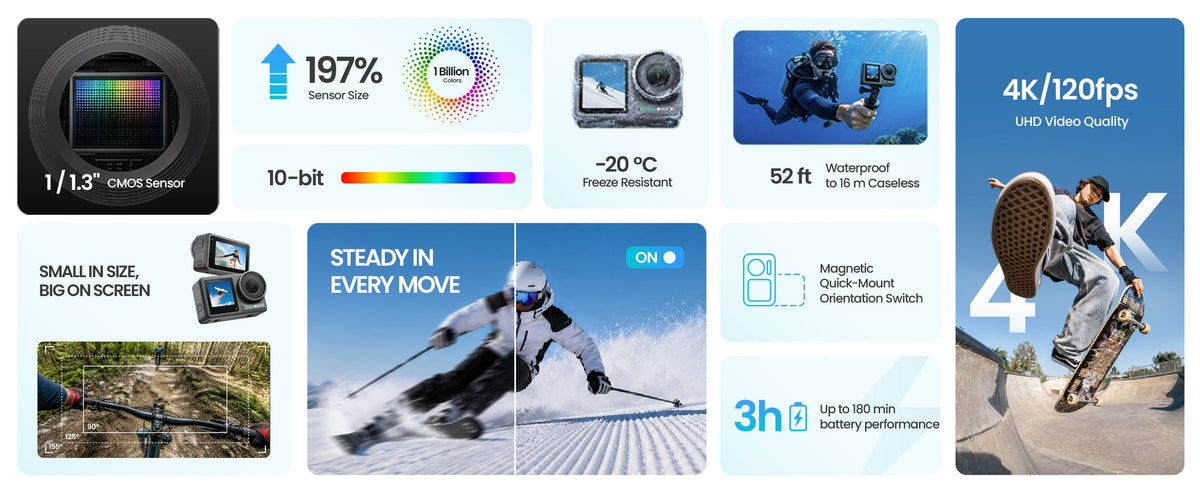
Use a real product as a reference, not a promise for the whole price bracket. The XTRA Edge camera and kit specifications show what one $179 option advertises. These six published numbers help assess a budget action camera; they do not establish its performance against competitors.
- 1/1.3-inch CMOS sensor: an imaging-hardware reference, not proof of superior footage in every scene.
- Up to 4K/120fps video: a high-frame-rate option; verify stabilization compatibility before choosing the recording mode.
- 16 m caseless waterproof rating: requires correctly closed covers and the manufacturer's water-use precautions.
- 149 g stated camera weight: mounts and accessories add weight to the complete setup.
- Up to 180 minutes: a laboratory result at 1080p/24, with stabilization, advanced features, Wi-Fi and screens off; not a 4K runtime promise.
- 80% charge in 18 minutes: measured at 25°C using a 30 W USB-C charger, with recording functions and screens off. Actual times vary.
The practical question is which capability helps your next shoot. For a daylight ride, mounting and stable framing may matter more than slow motion. For a short underwater clip, sealing instructions matter more than a second display. For a walking video, verify that you can quickly start recording without changing several settings.
A cheap 4K action camera may list the same resolution while offering different frame rates, stabilization restrictions or processing. Compare complete recording modes, not the word "4K" alone. After purchase, test a short clip in the actual light and mounting position you expect to use.
Set aside time for that test before a trip. Review the exported file rather than only the preview screen, check whether the horizon and subject remain framed, and listen for wind or handling noise. This does not require an expensive accessory kit; it requires checking your real workflow early.
Where the money should not go
A budget action camera purchase gets expensive when every possible future use becomes an accessory order. Buy for the next few shoots first. Keep a short list of problems the camera must solve, and postpone anything that does not address one of them.
- Do not chase the largest resolution number. Higher settings can create larger files and a heavier editing workload. Choose enough detail for your delivery format and the crop you actually need.
- Do not start with an ND filter collection. Filters serve particular exposure and motion-blur goals. Learn the camera's automatic exposure and stabilization behavior before buying specialized tools.
- Do not pay for a second screen solely because it exists. A front screen helps self-framing, but offers less value when the camera spends most of its time mounted out of sight.
- Do not automatically buy another battery. Buy one when planned recording time, cold conditions or limited charging access justify it. A short session and a remote all-day outing have different power requirements.
- Do not collect mounts without a shot plan. One secure, compatible mount used correctly is more useful than a drawer of adapters with unclear load limits.
That makes an affordable action camera a complete tool rather than the start of a shopping list. Keep enough budget for a supported memory card and any essential retention hardware. Revisit accessories after a real outing reveals a specific limitation.
Budget action camera vs phone: when $179 is worth it
Your existing phone has no additional camera purchase cost. For handheld travel clips, talking to camera and quick edits, keeping it may be the sensible decision. A budget action camera earns its place when a separate, mountable camera solves a problem your phone setup does not.
| Decision | Phone | Action camera |
|---|---|---|
| Stabilization | May already be good for walking; model and mode matter | Check vibration handling and supported modes |
| Water | Follow the specific phone's immersion guidance | Choose a documented rating and any required case |
| Mounting | Needs a suitable holder and puts your main phone at risk | Dedicated mounting can suit helmet, chest or bike viewpoints |
| Vertical video | Simple handheld portrait recording | Check mount orientation, recording mode and export crop |
The right choice for you may therefore be no new camera at all. Spend first on improving phone audio or support if those are your actual limitations. Conversely, separating filming from navigation, calls and phone battery use can be valuable on an outdoor trip.
Think about the cost of losing access to your phone during the activity, not just the cost of replacing it. A dedicated camera also creates another battery to charge and another set of files to manage. That trade-off is worthwhile only if the resulting viewpoint or convenience matters to you.
The best budget action camera under $250
There is no universal best budget action camera. This shortlist compares three models using official specifications and advertised U.S. prices checked September 29, 2026. Prices exclude any applicable tax, shipping and optional accessories. Stock and prices can change; these are not hands-on rankings.
| Candidate | Price reference | Published capability | Main decision |
|---|---|---|---|
| XTRA Edge | $179 camera; $239 Dual Battery Combo | 4K/120fps; 1/1.3-inch sensor; 16 m caseless rating | Compare the required recording mode and complete kit cost |
| AKASO Brave 7 | $169.99 Standalone | 4K/30fps; manufacturer lists 10 m body protection | Consider if 30fps meets your needs; check water-use guidance |
| AKASO Brave 7 LE | $139.99 Standalone | 4K/30fps; electronic stabilization; IPX7 body | Lower entry cost, but do not equate weather resistance with diving protection |
Brave 7 LE is below our suggested camera-only range and illustrates why that range is a starting point, not a minimum quality rule. AKASO's water-use guidance distinguishes its body protection from deeper-water use with a housing. Compare the exact package contents before treating either AKASO listing as a complete trip kit.
For Edge, the dual-battery package costs $60 more than the camera listing at this price snapshot. That is a package-price difference, not evidence that everyone needs the upgrade. To choose a practical kit for your situation, compare the leftover budget after the necessary card, mounting and power purchases.
For a broader shortlist, use our action camera buying guide. If your budget is capped at $300 and you shoot outdoors, read the outdoor camera guide under $300. The GoPro alternative guide considers a different brand-comparison question.
A five-minute budget checklist
Before buying a budget action camera, write down the total you can spend and complete these five checks. Use actual accessory prices rather than assuming a fixed percentage on top of the camera.
Now add the costs. If the total exceeds your limit, remove optional accessories or reconsider the camera, rather than saving money on an unsuitable card or unreliable mount. Keep your checklist for the first setup test.
FAQ
How much should you spend on a budget action camera?
We suggest starting around $150-250 for the camera, then pricing essential storage and mounting separately. This is a planning range, not a promise of a particular sensor or waterproof rating. If you already own a usable camera, solving an accessory limitation may cost less than replacing it.
Is a $179 action camera good enough for outdoor filming?
It can be, depending on your activity and expectations. Verify the particular model's recording modes, stabilization, weather protection and mounting options. Price alone does not guarantee 4K/120fps, underwater use or a specific runtime. Test the chosen setup before relying on it for an important trip.
Do you need 4K, or is 1080p enough on a budget?
1080p can be sufficient for publishing, while 4K offers more room for cropping. Lower-resolution recording may reduce storage and power demands, but the difference depends on bitrate, frame rate and camera settings. It does not automatically double storage capacity or battery runtime.
Are cheap action cameras waterproof without a case?
Not all of them. Verify the rating for the camera body separately from any housing. Check depth, duration and use restrictions, plus the manufacturer's sealing instructions. A cheap 4K action camera can still need a case, changing its cost, bulk and underwater audio performance.
What is the best budget action camera for cycling?
Prioritize stabilization in your preferred recording mode, secure compatible mounting and enough power for the planned recording time. Consider where the camera sits and what it can see. Resolution alone cannot compensate for a loose mount or poor framing.
How much does the whole kit really cost?
Add the camera, a supported memory card, the necessary mount and any justified spare battery or housing. There is no universal 15-25% accessory allowance. Compare identical contents when evaluating bundles, and include any applicable shipping and tax in your final budget.
Is a budget action camera better than a phone for travel?
A phone can be a strong choice for handheld clips and quick editing. A separate action camera can suit mounted viewpoints, water use within its rating and filming without consuming your phone's battery or storage. Choose according to the shot, not the category label.
What should you skip when buying on a budget?
Postpone filters, specialty lenses and redundant mounts until you have a specific need. Decide on a spare battery from recording duration and charging access, not a blanket rule. Spend first on compatible storage, secure mounting and the protection required by your activity.
Is XTRA Edge a budget action camera?
At the checked U.S. prices, Edge is $179 and the Dual Battery Combo is $239. Its published capabilities include a 1/1.3-inch sensor, 4K/120fps and 16 m caseless protection. Two batteries do not guarantee all-day recording. See Edge kits and current prices.
The bottom line
Choose a budget action camera by the complete cost of getting your intended shot, not the biggest number on its box. Start with the camera, card and essential mounting; add power and protection when your use case requires them. Compare XTRA action cameras and kits to see the available setups. If low-light capability matters more than the lowest price, review Edge Pro's imaging modes and specifications as well; this guide does not establish a measured low-light winner.


Leave a comment
This site is protected by hCaptcha and the hCaptcha Privacy Policy and Terms of Service apply.