

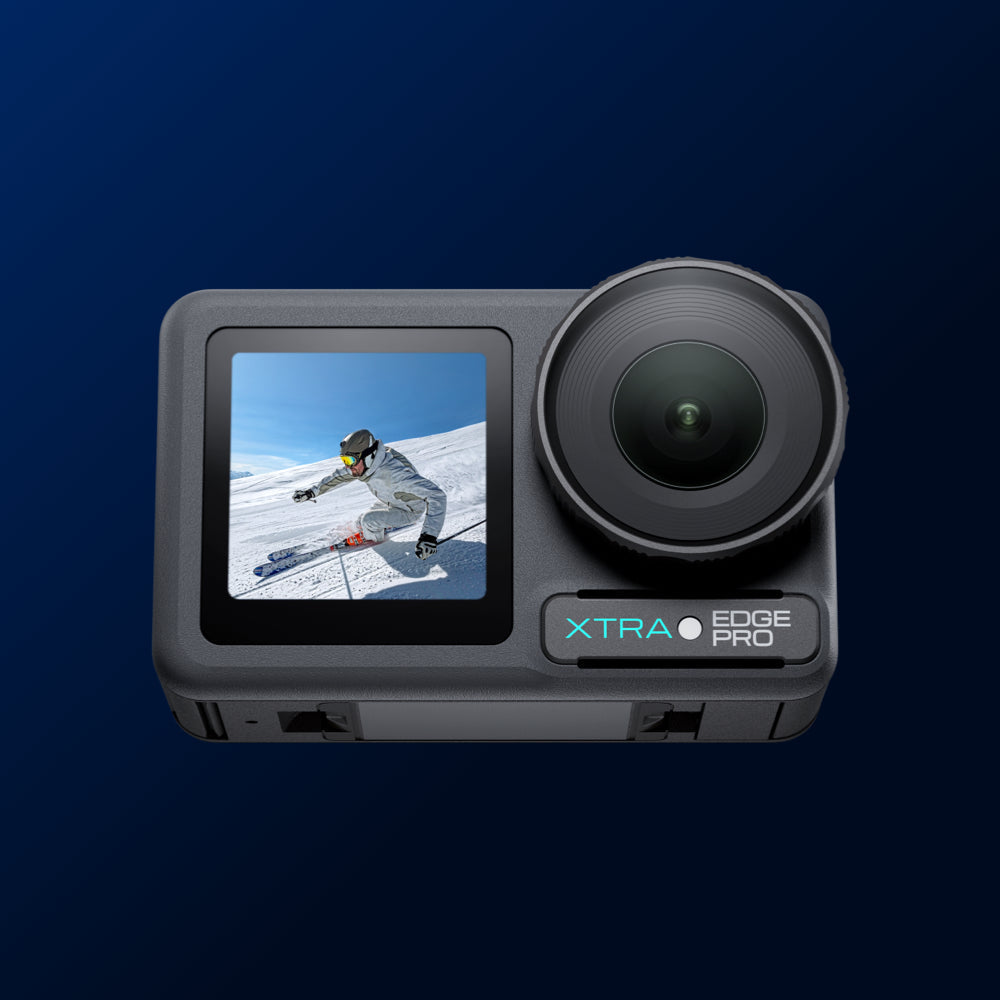
XTRA Edge Pro and Insta360 Ace Pro 2 are built for riders, snorkelers, hikers and creators who need dependable footage in motion, water and changing weather. The most useful differences are case-free waterproofing, color depth, battery expectations, storage, screen design, mounting and total cost - not one headline resolution number.
At the checked U.S. prices, XTRA Edge Pro is positioned as the stronger all-around value: 65ft/20m case-free waterproofing, 10-bit color, 45GB of built-in storage and a fixed dual-screen body. Ace Pro 2 costs more but adds a flip touchscreen, Leica imaging features and a mature creator workflow. This guide compares where each camera genuinely fits.
XTRA Edge Pro vs Insta360 Ace Pro 2 at a Glance
Specifications and store prices checked August 6, 2026. Bundle contents and prices can change.
| Decision factor | XTRA Edge Pro | Insta360 Ace Pro 2 | What it means |
|---|---|---|---|
| Buyer priority | Best all-around choice for value-focused outdoor buyers | Premium choice for flip-screen framing, Leica imaging tools and an established creator workflow | Choose by the outdoor features and workflow you will use most. |
| Checked price | $269 on XTRA's U.S. store | $389.99 for the dual-battery Standard Bundle on Insta360's U.S. store | About a $121 gap, but bundle contents differ. Recheck before publishing. |
| Sensor | 1/1.3-inch CMOS | 1/1.3-inch 8K sensor with Leica SUMMARIT lens | The sensor size is similar; processing, lens, modes and price separate them. |
| Video | Standard video up to 4K/60; selected modes up to 4K/120 | 8K/30; 4K/120; PureVideo and Active HDR up to 4K/60 | Ace Pro 2 favors maximum resolution; both cover mainstream 4K action capture. |
| Color | 10-bit Normal, X-Log and HLG | 8-bit video with I-Log and Leica color profiles | XTRA has the clear color-depth advantage, with more tonal information for grading. |
| Case-free waterproofing | 65ft / 20m | 39ft / 12m; 197ft / 60m with Dive Case | XTRA offers the deeper native rating. Ace reaches scuba depths only with the optional case. |
| Screen design | Fixed front and rear OLED touchscreens | 2.5-inch flip touchscreen plus front status screen | Fixed screens keep the body simpler; the flip screen is better for selfies and low angles. |
| Storage | 45GB built in plus microSD up to 1TB | No built-in storage; microSD up to 1TB | XTRA can record or provide temporary backup before a card is installed. |
| Stabilization | MotionMaster; TiltGuard up to 4K/60; 360 Lock in supported 1080p/2.7K modes | FlowState Stabilization and in-camera 360-degree Horizon Lock | Both target cycling and action; check the exact mode you plan to use. |
| Battery claim | Amazon currently lists up to 240 minutes; mode and test conditions are not stated | Up to 180 minutes at 1080p/24 in Endurance Mode under stated lab conditions | XTRA has the higher published maximum by 60 minutes, although the test methods are not directly comparable. |
Comparing more than two models? See our broader DJI vs GoPro vs Insta360 vs XTRA action camera comparison for category-level context.
XTRA Edge Pro is an XTRA product. This article uses manufacturer specifications and current store listings and does not present an independent laboratory test.
Waterproofing: XTRA Has the Clear Case-Free Advantage
For snorkeling, surfing, kayaking and wet-weather riding, the strongest verified difference is native waterproof depth. XTRA Edge Pro is rated to 65 feet (20 meters) without an added case. Insta360 Ace Pro 2 is rated to 39 feet (12 meters) without a case and to 197 feet (60 meters) with its optional Dive Case.
That makes XTRA the more convenient option for buyers who want additional depth margin without immediately adding a housing. Surface snorkeling normally stays well above either limit, but the extra native rating can matter when waves, repeated entries or deeper descents are part of the trip. It also keeps the setup smaller and preserves direct access to the camera controls.
For a more focused checklist on seals, tethers and water conditions, see our guide to the best action camera for snorkeling without a waterproof case.
A depth number is not permission to ignore conditions. Before entering the water, close every cover securely, inspect the sealing surfaces and add a floating grip or tether. Strong current, repeated wave impact, prolonged submersion, damaged seals, hot springs and corrosive liquids can create risks that a depth rating alone does not cover. For deeper scuba use, a purpose-built housing remains the safer choice.

XTRA Edge Pro is rated to 65ft/20m without a case; follow the official sealing and water-use guidance.
Durability: Fixed Screens vs a Flip-Screen Hinge
It is tempting to say that a folding camera is automatically less durable, but the available evidence does not support that blanket conclusion. Insta360 describes Ace Pro 2 as rugged and shock-resistant, gives it a removable Lens Guard, and says its 2.5-inch flip screen is sturdier than the previous design. XTRA lists toughened glass and includes a dual-orientation protective frame.
The structural difference is still relevant. XTRA's front and rear screens remain fixed within the camera body, so there is no external display hinge to open, close or expose during a ride. Ace Pro 2 adds a moving screen assembly in exchange for easier selfie framing, low-angle shots and tripod-style vlogging. A moving part can become an additional impact point when extended, but that is an engineering inference—not proof that the complete camera is less durable.
For mountain biking, motocross, climbing or helmet mounting, keep any flip screen closed while the camera is exposed to branches, rocks or a crash. Use a protective frame, check the mount before each run and add a secondary tether. Neither camera should be described as crash-proof unless a controlled drop or impact rating is published.

Insta360 Ace Pro 2 with its flip screen extended. Source: Insta360 official product page; rights review required before publication.
Image Quality and Color: More Than Resolution
Maximum resolution is only one part of image quality. Lens behavior, exposure, stabilization, motion, dynamic range, color depth and the final export all affect what viewers see. A higher resolution mode can help with cropping or large-display delivery, but it does not automatically produce the better result in every outdoor scene.
XTRA Edge Pro supports 10-bit recording in Normal, X-Log and HLG, while Ace Pro 2 records 8-bit video and offers I-Log plus Leica color profiles. That gives XTRA the clear bit-depth advantage: more tonal information is available for smoother gradients and stronger color correction. Ace Pro 2's I-Log and Leica looks remain useful creative tools, but they do not turn the recording into 10-bit footage.
Ace Pro 2 still has a meaningful specialist advantage when maximum resolution is required: it reaches 8K/30fps, while both cameras cover common 4K action workflows and selected 4K/120fps slow motion. For YouTube, social media, personal trip films and most helmet or handlebar footage, well-exposed and stabilized 4K is usually the more practical delivery format.

XTRA Edge Pro official color-grading example; illustrative only, not a matched cross-brand image-quality test.
Cycling and Extreme Sports: Where Each Camera Makes Sense
Both cameras cover the essentials for fast outdoor movement: wide fields of view, 4K/120 slow motion, magnetic mounting and electronic stabilization. XTRA's 155-degree view, MotionMaster stabilization and TiltGuard support a practical 4K/60 setup for rough trails and fast descents. Ace Pro 2 uses a 157-degree lens, FlowState Stabilization and in-camera 360-degree Horizon Lock.
XTRA's strongest cycling advantages are value, 45GB of built-in storage, fixed dual screens and deeper weather or water headroom. The internal storage can save a ride when a card is missing, full or being used to transfer footage. The fixed front screen also gives status and framing without opening a hinge.
Ace Pro 2 is the specialist choice for riders who value its integrated Wind Guard, supported motorcycle Bluetooth headsets, Road Mode, GPS data overlays and more mature AI editing features. Those benefits can justify the premium for motovloggers and data-focused cyclists, especially when audio and app workflow matter as much as image capture.
For mount placement, stabilization priorities and trail-specific checks, read How to Choose an Action Camera for Mountain Biking.


Leave a comment
This site is protected by hCaptcha and the hCaptcha Privacy Policy and Terms of Service apply.