

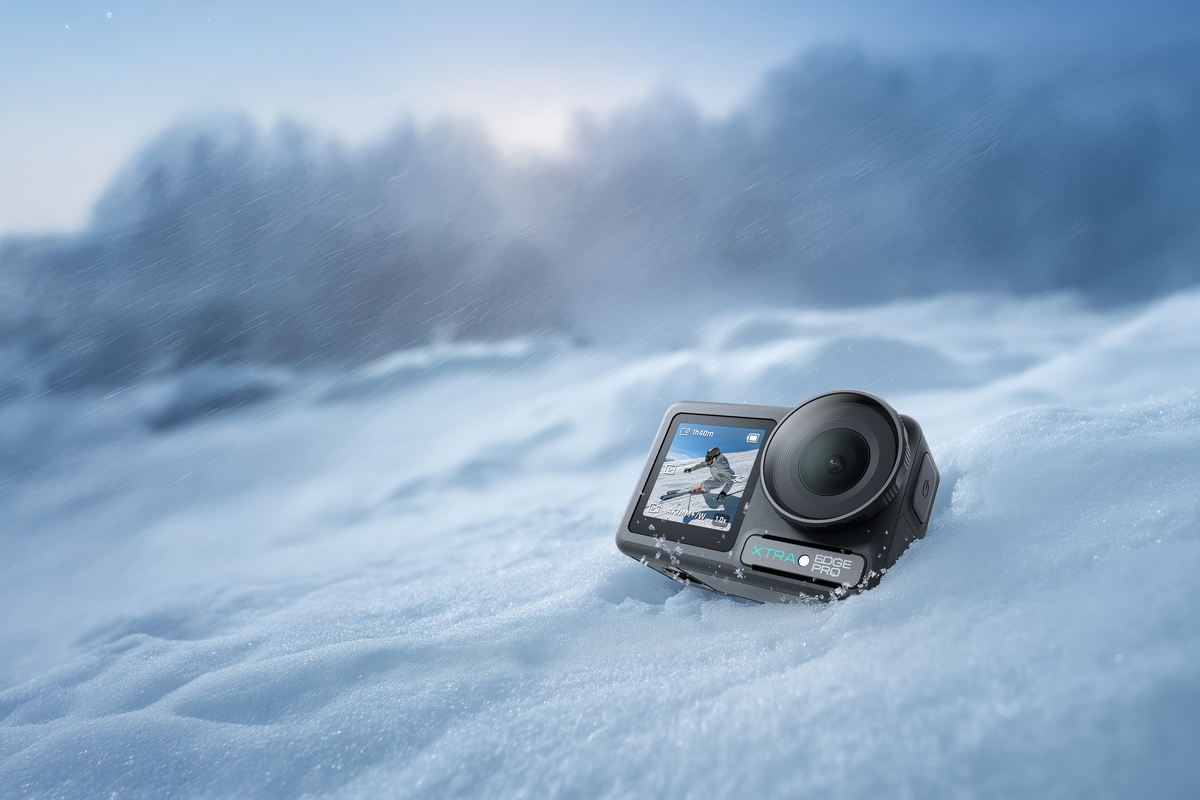
For buyers comparing XTRA Edge Pro vs DJI Osmo Action 5 Pro, both cameras target the same practical need: a fixed-screen action camera for rough rides, wet trips, cold days and fast-moving footage. Because both offer a 1/1.3-inch sensor, 10-bit log recording, 65ft/20m case-free waterproofing, built-in storage and magnetic mounting, the decision depends more on price, workflow and the exact modes you will use.
At the checked U.S. prices, XTRA Edge Pro costs $269 and DJI's one-battery Standard Combo costs $349. XTRA therefore competes by covering the core outdoor requirements for $80 less, while DJI earns its premium through a more established workflow, direct wireless microphone integration and more fully documented specialist features. This guide separates meaningful differences from near-ties.
XTRA Edge Pro vs DJI Osmo Action 5 Pro at a Glance
| Decision factor | XTRA Edge Pro | DJI Osmo Action 5 Pro | What it means |
|---|---|---|---|
| Buyer priority | Best all-around choice for value-focused outdoor buyers | Premium choice for established workflow, direct DJI microphone integration and documented specialist features | XTRA leads on checked price-to-feature value; DJI leads on ecosystem and workflow maturity. |
| Checked price | $269 on XTRA's U.S. store | $349 for DJI's Standard Combo with one battery | XTRA is $80 lower at the checked prices. Recheck both listings before publishing. |
| Sensor | 1/1.3-inch CMOS | 1/1.3-inch CMOS | Both use the same sensor-size class; processing, tuning and modes still affect results. |
| Video | Standard video up to 4K/60; selected modes up to 4K/120 | Standard video up to 4K/120; SuperNight up to 4K/60 | Both cover mainstream 4K action capture; DJI documents more 4K/120 standard-recording options. |
| Color | 10-bit Normal, X-Log and HLG | 10-bit D-Log M and HLG | Both provide 10-bit log and HDR-oriented workflows; profile handling differs by brand. |
| Case-free waterproofing | 65ft / 20m; optional 197ft / 60m case | 65ft / 20m; optional 197ft / 60m case | Published depth ratings are effectively equal. Follow each brand's sealing and water-impact guidance. |
| Screen design | Fixed front and rear OLED touchscreens | Fixed front and rear OLED touchscreens | Both avoid an external flip-screen hinge and support front or rear framing. |
| Storage | 45GB built in plus microSD up to 1TB | 47GB usable built in plus microSD up to 1TB | Both can record without a card; DJI publishes 2GB more usable internal space. |
| Stabilization | MotionMaster; TiltGuard up to 4K/60; 360 Lock in supported 1080p/2.7K modes | RockSteady 3.0/3.0+; HorizonBalancing up to 4K/60; HorizonSteady up to 2.7K/60 | Both support leveled action footage, with mode-specific limits that should be checked before a ride. |
| Battery claim | Amazon lists up to 240 minutes; reviewed field does not state the mode or conditions | Up to 240 minutes at 1080p/24 with RockSteady on, Wi-Fi and screens off at 77°F / 25°C | The headline maximum is equal, but DJI publishes a reproducible test condition and XTRA's reviewed field does not. |
Specifications and U.S. store prices checked August 7, 2026. Bundle contents and prices can change.
Comparing more than two models? See our broader DJI vs GoPro vs Insta360 vs XTRA action camera comparison for category-level context.
XTRA Edge Pro is an XTRA product. This article uses manufacturer specifications and current store listings and does not present an independent laboratory test.
Price and Total Kit Value: XTRA's Strongest Advantage
When this draft was prepared, XTRA's U.S. store listed Edge Pro at $269 and DJI's U.S. store listed the one-battery Osmo Action 5 Pro Standard Combo at $349. The $80 difference is the clearest reason to consider XTRA: it still includes the same sensor-size class, 10-bit log recording, 20m native waterproofing, dual OLED screens, built-in storage and magnetic mounting.
That does not make the two bundles identical. Compare the battery count, protective frame, adhesive base, mounting adapters, charging accessories, microphone needs and water housing you will actually use. DJI's direct connection to supported DJI wireless microphones and broader accessory workflow may be worth the premium for established DJI creators. Buyers building a straightforward outdoor kit can keep more of their budget for a spare battery, memory card, tether or activity-specific mount with XTRA.
If $300 is your practical ceiling, use our best action camera under $300 guide to compare the features that matter most at this price.
Image Quality and Color: Similar Hardware, Different Workflows
Both cameras use a 1/1.3-inch CMOS sensor and support 10-bit capture with a log profile and HLG. XTRA provides X-Log and HLG, while DJI provides D-Log M and HLG. That puts both in the same broad category for creators who want more grading flexibility than a basic 8-bit workflow, but it does not prove that exposure, color science, noise reduction or highlight recovery will match in a real scene.
DJI documents standard 4K recording up to 120fps, SuperNight up to 4K/60 and built-in subject centering and tracking in selected 2.7K and 1080p modes. XTRA documents stabilized 4K/60 standard recording, selected 4K/120 modes, Night View and smart subject tracking. DJI has the stronger published specialist workflow; XTRA covers the mainstream 4K formats most outdoor buyers actually deliver at a lower price.
A responsible image-quality verdict requires both cameras on the same mount, route, settings and export. Until that test exists, treat sensor size, bit depth and mode lists as capabilities rather than proof of a universal winner.

DJI Osmo Action 5 Pro official product image. Source: DJI official store; rights review required before publication.
Waterproofing: A Practical Tie at 65ft Without a Case
XTRA Edge Pro and DJI Osmo Action 5 Pro are both rated to 65 feet (20 meters) without a waterproof case. Each brand also offers an optional housing rated to 197 feet (60 meters). For snorkeling, surfing, kayaking, rafting and rain, neither camera has a published native-depth advantage in this comparison.
For a focused water-use checklist, read our guide to the best action camera for snorkeling without a waterproof case.
The equal depth number should not be treated as permission to ignore conditions. Close every cover, inspect the lens cover and sealing surfaces, rinse after saltwater use, and add a floating grip or tether. Both brands recommend a housing for prolonged underwater recording or environments with strong water-impact pressure. Use an appropriate dive case for deeper scuba activity.
Both cameras use fixed front and rear screens rather than an external flip-screen hinge. That is useful around rocks, branches and mounts, but neither camera should be called crash-proof or drop-proof without a shared controlled impact test.
Cycling and Extreme Sports: Choose by Workflow
Both cameras offer a 155-degree field of view, magnetic quick-release mounting and electronic stabilization. XTRA combines MotionMaster with TiltGuard up to 4K/60 and 360 Lock in supported 1080p and 2.7K modes. DJI combines RockSteady 3.0/3.0+ with HorizonBalancing up to 4K/60 and HorizonSteady up to 2.7K/60. On paper, both cover helmet, chest and handlebar use; the exact mode limits matter more than the stabilization name.
XTRA's cycling case is built around value: 45GB of internal storage, fixed dual screens, a magnetic mount and the core stabilization modes without the $349 entry price. DJI's specialist advantage is workflow. Supported DJI Mic transmitters can connect directly without a receiver, and DJI's documented subject tracking, accessory options and established app ecosystem can save setup time for motovloggers or creators already using DJI gear.
For mount position, frame-rate and tether guidance, read How to Choose an Action Camera for Mountain Biking.

XTRA Edge Pro magnetic cycling mount shown in an outdoor setup.
Battery and Storage: Near Parity, but Different Evidence
Both brands publish an up-to-240-minute battery figure. DJI states its test condition: 1080p/24fps at 77°F (25°C), RockSteady on, Wi-Fi off and both screens off. XTRA's current Amazon Product Information field also lists up to 240 minutes, but the reviewed field does not identify the recording mode or test conditions. The matching headline is not a controlled battery tie until both cameras are tested under the same setup.
Do not plan a 4K/60 ride around either maximum. Frame rate, stabilization, screen brightness, wireless connections, temperature and continuous recording can materially reduce runtime. Charge before leaving and carry an appropriate spare or power plan for a full-day ride or dive.
Internal storage is also close: XTRA includes 45GB, while DJI specifies 47GB usable. Both accept microSD cards up to 1TB. DJI has a small 2GB capacity edge, but either camera can rescue a session when a card is missing, full or temporarily being used for file transfer.
Which Camera Should You Buy?
Choose XTRA Edge Pro If You...
- Want the best all-around choice for value-focused outdoor buyers, based on a checked $269 price and a strong published feature set rather than an unsupported universal performance win.
- Want to save about $80 while keeping a 1/1.3-inch sensor, 10-bit X-Log/HLG, dual OLED screens and 65ft/20m case-free waterproofing.
- Need 45GB of built-in storage as a practical fallback plus microSD expansion up to 1TB.
- Shoot cycling, snorkeling, hiking, skiing or general outdoor footage and do not depend on DJI microphone integration or the DJI creator ecosystem.
- Prefer to spend the remaining budget on a spare battery, memory card, tether, dive housing or activity-specific mount.
Frequently Asked Questions
Why consider XTRA Edge Pro if my budget is under $300?
At the checked $269 price, XTRA Edge Pro combines a 1/1.3-inch sensor, 10-bit X-Log/HLG, 65ft/20m case-free waterproofing, dual OLED screens, 45GB of built-in storage and magnetic mounting. It is a strong value option for buyers who want the core outdoor feature set and do not need a more expensive ecosystem-specific workflow.
Does XTRA Edge Pro support 10-bit video?
Yes. XTRA Edge Pro supports 10-bit Normal, X-Log and HLG. That gives creators more color information and grading flexibility than a basic 8-bit workflow, although the best profile depends on the scene and editing plan.
How deep can XTRA Edge Pro go without a waterproof case?
XTRA Edge Pro is rated to 65ft/20m without a case when the battery and USB-C covers are fully closed. Inspect the seals before every water session, use a tether or floating grip, and add an appropriate housing when depth, duration, impact or the activity requires more protection.
Does XTRA Edge Pro have built-in storage?
Yes. XTRA Edge Pro includes 45GB of built-in storage and supports microSD cards up to 1TB. The internal space is useful when a card is missing, full or being used for transfer, while a compatible card remains the better choice for long 4K sessions.
Does XTRA Edge Pro really record for 240 minutes?
Amazon currently lists up to 240 minutes, but the reviewed field does not identify the mode or test conditions. Do not assume 240 minutes at 4K/60. Actual runtime changes with resolution, frame rate, stabilization, screens, wireless use and temperature.
Is XTRA Edge Pro a good camera for cycling and mountain biking?
Yes. Its magnetic quick mount, fixed dual screens, MotionMaster stabilization, TiltGuard support up to 4K/60 and 45GB of built-in storage suit cycling workflows. Use a compatible activity mount, verify the connection before every ride and add a secondary tether for higher-risk terrain.
The Bottom Line
The XTRA Edge Pro vs DJI Osmo Action 5 Pro comparison is unusually close on the published outdoor fundamentals. Both cameras use a 1/1.3-inch sensor, support 10-bit log and HLG workflows, reach 65ft/20m without a case, offer dual OLED screens and magnetic mounting, include internal storage, and publish up to 240 minutes of battery life.
The purchase decision therefore comes down to value and workflow. DJI Osmo Action 5 Pro is the stronger specialist choice for buyers who prioritize direct DJI microphone integration, DJI's established accessory and app ecosystem, and more fully documented mode and endurance testing. XTRA Edge Pro is the stronger all-around value for outdoor buyers who want comparable core capabilities at the checked $269 price - about $80 less than DJI's one-battery Standard Combo.

Leave a comment
This site is protected by hCaptcha and the hCaptcha Privacy Policy and Terms of Service apply.